
In the realm of environmental discourse, the terms “weather” and “climate” are often employed interchangeably, resulting in widespread ambiguity. The misunderstanding extends beyond casual conversation; it seeps into educational materials, public policy, and even scientific discourse. To elucidate this distinction, it is imperative to delve into the fundamental characteristics of each phenomenon, their respective implications, and why recognizing their difference holds significant weight in addressing environmental challenges.
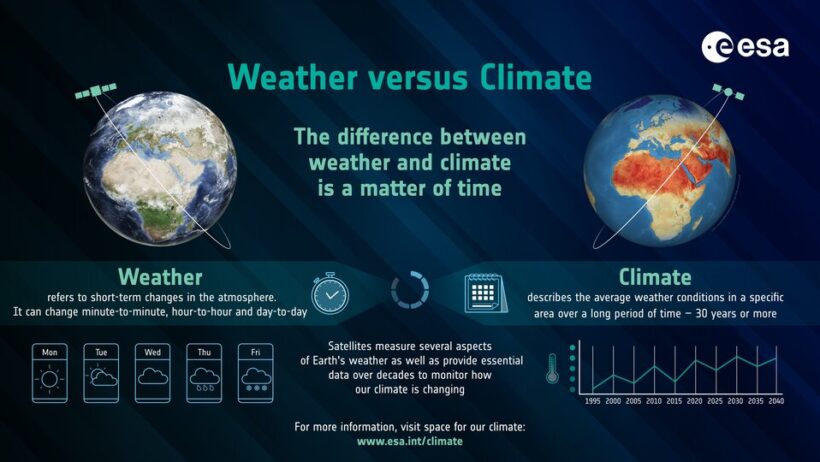
Weather refers to the short-term atmospheric conditions in a particular locale at a specific time. This includes variables such as temperature, humidity, precipitation, wind direction, and atmospheric pressure, all of which fluctuate on a minute-to-minute, hour-to-hour, or day-to-day basis. For instance, one may experience a sunny afternoon followed by an unexpected downpour—a clear illustration of the capricious nature of weather. This variability is a result of complex interactions between the Earth’s atmosphere, land, and bodies of water, influenced by local geography and meteorological phenomena.
Climate, conversely, embodies the long-term average of weather patterns over a much more extended period—typically 30 years or more—in a specified region. Climate encompasses a broader spectrum of data, summarizing weather patterns to classify regions under specific climatic zones: tropical, arid, temperate, polar, and more. This encapsulation allows for an understanding of trends and cycles, enabling scientists and climatologists to compare data across decades and make predictions based on historical records.
To visualize the difference, consider the juxtaposition of a single day of torrential rain against the overarching classifications of a region’s climate. A city classified as having a temperate climate may experience a multitude of weather events within that classification: sunny days, rainy spells, and even snow. However, the long-term observations will ultimately depict a pattern where such weather occurs within the broader parameters established by its climate. Thus, the weather provides a snapshot, while climate furnishes a comprehensive portrait of atmospheric behavior.
This distinction is not merely academic; it has profound implications. Misunderstanding the difference can lead to misconceptions regarding climate change. Weather provides the immediate context, yet climate outlines the long-range trajectories of environmental shifts—global warming, ice cap melting, or changes in precipitation patterns. For instance, an isolated instance of unseasonably cold weather cannot be taken as evidence against the burgeoning trend of climate change. Herein lies a critical misstep in public discourse, wherein short-term weather fluctuations may be incorrectly extrapolated to negate long-term climatic trends.
Moreover, weather influences daily decision-making: from how one dresses to public safety during severe events. The significance of weather is palpable and immediate, shaping human activity in real-time. In contrast, climate shapes societal infrastructure, long-term agricultural planning, and even governmental policies on disaster preparedness. Urban planners, for instance, integrate climate data into their designs to ensure structures are resilient to long-term environmental changes, such as rising sea levels or increased storm frequency.
Consider the implications for agriculture—farmers must take both weather and climate into account to optimize crop yields. Weather forecasts offer guidance on daily irrigation needs, while knowledge of climate patterns informs strategic choices related to crop selection and planting schedules. The importance of this nuanced understanding cannot be overstated; failing to recognize the distinct roles of weather and climate can result in economic ramifications, food insecurity, and resource depletion.
In educational contexts, it is paramount that curricula specify the differences between weather and climate to cultivate informed citizenship. Engaging students with real-world examples—such as the contrast between a sudden winter storm and the gradual warming trends observed over decades—fosters a deepened appreciation for environmental science. Such understanding instills a sense of responsibility, emphasizing how individual actions contribute to broader climatic outcomes.
Furthermore, as we confront pressing global environmental issues, the distinction between weather and climate becomes even more critical in advocacy and communication. As voices cry out for sustainability and action against climate change, it is essential that advocacy be grounded in scientifically accurate representations of environmental dynamics. Misrepresentation can undermine public trust and engender skepticism towards valid scientific evidence regarding climate change.
In conclusion, distinguishing between weather and climate is not merely an academic exercise; it is pertinent to effective communication regarding environmental issues and sustainable practices. The significance of weather lies in its immediacy and unpredictability, while climate encapsulates overarching patterns that dictate long-term environmental trajectories. By understanding these differences, we empower ourselves and future generations to confront the challenges posed by a changing environment with informed urgency. Only through a clear comprehension of these terms can individuals and societies alike engage in meaningful discussions and actions towards a sustainable future.