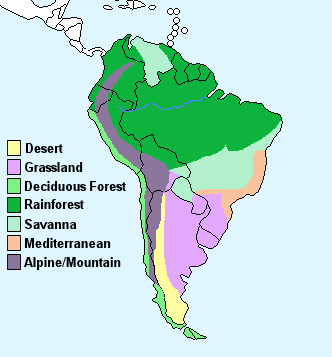

Paraguay, a landlocked nation in the heart of South America, possesses an intricate climate characterized by its subtropical heat and precipitation patterns. What does living under the Paraguayan sun truly entail? And if one could encapsulate this climate within a singular definition, what complexities would arise?
To commence, it is crucial to understand that Paraguay experiences a humid subtropical climate across most of its territory. This climate classification is noted for its warm temperatures and significant rainfall, particularly in the eastern regions. Typically, the temperature ranges from mild in the south to considerably warmer conditions in the north, creating an assortment of microclimates that greatly influence agricultural practices and biodiversity.
The Paraguay River acts as a natural divider between regions. On the east, individuals encounter verdant landscapes replete with lush vegetation and diverse wildlife, while the western regions, particularly the Chaco, present a striking contrast. The Chaco is marked by drier and hotter periods, which can pose intriguing challenges for both flora and fauna striving to adapt to such extremes.
Throughout the year, Paraguay experiences four distinct seasons: summer, autumn, winter, and spring. Summer, lasting from December to February, showcases a stunningly warm climate. Average temperatures soar above 30 degrees Celsius (86 degrees Fahrenheit), with peaks that can reach into the low forties Celsius (over 104 degrees Fahrenheit). Such heat fosters a vibrant yet intense environment, inviting both locals and tourists to engage in outdoor activities during daylight hours. However, the sweltering conditions also raise concerns about water scarcity and its management, especially in rural communities reliant on agriculture.
As the seasons transition into autumn and winter, temperatures begin to drop. Autumn, spanning March to May, heralds a refreshing change, where daytime temperatures hover around 25-30 degrees Celsius (77-86 degrees Fahrenheit). Winters are relatively mild, occurring from June to August, with average daytime temperatures tapering off to a comfortable range of 10-20 degrees Celsius (50-68 degrees Fahrenheit). During this period, one may ponder whether winter is truly a respite or merely a prelude to the upcoming heat.
Snowfall is an anomaly in Paraguay, as the country rarely experiences such phenomena. However, residents often encounter frosty nights, particularly in the southern regions. This unusual climate feature presents challenges for those accustomed to milder temperatures and serves as a reminder of the planet’s intricate climatic systems.
Rainfall in Paraguay is another paramount aspect of its climate, with the eastern part of the country receiving significant precipitation, averaging between 1,500 to 2,000 millimeters (59 to 79 inches) annually. The rainy season typically spans from October to March, providing the much-needed water for agriculture and fostering lush growth. But, one must acknowledge the potential ramifications of heavy rainfall; flooding can wreak havoc on communities, disrupt food production, and trigger landslides in vulnerable areas.
In stark contrast, the western Chaco region receives considerably less rain, averaging about 800 to 1,200 millimeters (31 to 47 inches) annually. The arid spells challenge inhabitants and wildlife to adapt their behaviors and survival strategies, reflecting the resilient spirit inherent in the diverse ecosystems of Paraguay. How do these species endure such extremes, and what adaptations have they developed over generations?
Climate change poses a dual challenge for Paraguay, exacerbating existing meteorological phenomena and introducing new climatic uncertainties. The increasing frequency of extreme weather events, such as droughts and torrential downpours, presents a daunting hurdle for farmers relying on predictable seasonal patterns for their crops. These challenges compel communities to devise innovative strategies to mitigate potential damages and bolster resilience against ever-changing conditions.
This climatic volatility is further complicated by environmental degradation and deforestation. As agriculture expands into previously untouched regions, crucial habitats are lost, impacting biodiversity and local ecosystems. The interdependence between climate, agriculture, and biodiversity calls for a delicate balance, wherein sustainable practices must be prioritized to ensure the survival of both ecosystems and human livelihoods.
Aside from local consequences, Paraguay’s climate is part of a larger global system wherein the consequences of climate change reverberate across continents. As the planet warms, changes in Paraguay’s climate may contribute to shifts in global weather patterns, with potential impacts on agriculture not only locally but also in distant countries relying on Paraguayan exports. The interconnectedness of nations underscores the importance of addressing climate issues collectively.
In conclusion, Paraguay’s subtropical climate is both captivating and challenging, characterized by its extremes of heat and rain. Both its inhabitants and ecosystems have adapted to these conditions, but they face mounting pressures due to climate change and human activity. Will Paraguay be able to maintain its delicate ecological balance in the face of such a formidable challenge? Only through concerted efforts, innovative strategies, and a commitment to sustainability can the nation navigate its complex climatic future while fostering resilience and preserving its unique environmental heritage.