

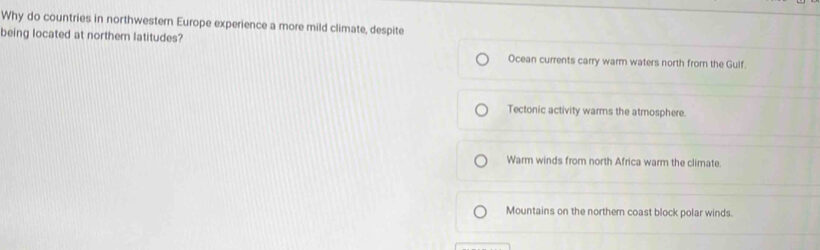

Imagine standing on the windswept shores of the British Isles, where the gentle waves lap against the coast, and the air is infused with a mildness that beckons you to linger. What if I told you that this enchanting climate, often resembling a tempered embrace, is not solely an act of nature but rather the work of an unseen force known as ocean currents? Indeed, a playful inquiry arises: What ocean current graciously bestows these balmy winters upon Northwestern Europe? The answer lies in the intricate dance of the North Atlantic Drift, a vital artery of warmth flowing across the ocean.
The North Atlantic Drift, an extension of the Gulf Stream, carries warm water northward from the tropics. This current begins its journey in the Gulf of Mexico, where it absorbs heat from the sun, generating a substantial amount of warm water. As it progresses towards the northwestern edge of Europe, this current collects additional warmth and moisture from the surrounding oceanic environment. It is this very influx of temperate water that modulates the climate of countries like the UK, Ireland, and parts of Scandinavia, allowing them to escape the frigid grasp of winter that engulfs many other regions at similar latitudes.
But how does this hydrological phenomenon wield such influence? One must consider the principles of heat transfer and atmospheric circulation. As the North Atlantic Drift flows across the Atlantic Ocean, it heats the air above it, leading to a rise in temperature in the surrounding landmasses. Moreover, the gentle breezes that emerge from this current help to equalize temperature discrepancies, mitigating extreme temperature fluctuations between day and night. Thus, the region experiences milder winters compared to places like Canada or Siberia, where the Arctic air prevails.
This unprecedented warmth is particularly striking when utilizing a comparative lens to examine other global locales. Cities situated at similar latitudes, such as Montreal in Canada, experience harsh winters characterized by heavy snowfall and bone-chilling temperatures. In contrast, London enjoys a temperate climate, rarely witnessing extreme cold. While the geographic positioning of these areas plays a role, the presence of the North Atlantic Drift elucidates the stark differences in climate, rendering it a crucial component of Northwestern Europe’s weather system.
The impacts of the North Atlantic Drift extend beyond mere temperature moderation; they ripple through numerous ecological and economic dimensions. For instance, the mild winters foster a conducive environment for agriculture, enabling the cultivation of crops that would otherwise be impossible at such latitudes. The region benefits from extended growing seasons, which play an essential role in food security and local economies. Furthermore, this temperate climate draws tourists eager to escape winter’s icy clutches, bolstering the service and hospitality sectors.
However, the benevolent effects of the North Atlantic Drift are increasingly threatened by climate change. As global temperatures rise, the melting polar ice caps contribute excess freshwater to the North Atlantic, potentially disrupting the current’s flow. The delicate balance that allows for this warming current could become jeopardized, leading to unpredictable consequences for Northwestern Europe’s climate. An intriguing yet disconcerting challenge emerges: what if the very warmth that supports human life and agriculture begins to wane?
This looming quandary invites closer scrutiny of the consequences of changing ocean dynamics. The thermohaline circulation, or the global conveyor belt, relies on the intricate interplay of temperature and salinity. Should enough freshwater dilute the salinity of ocean waters, the driving force behind these currents could diminish. This scenario poses serious implications, not only for temperatures but also for weather patterns. The repercussions may manifest as intensified storms, unpredictable precipitation, and changing marine ecosystems, threatening biodiversity that is crucial to both human livelihoods and the health of our planet.
As global citizens concerned about our changing climate, awareness and action are imperative. Engaging in practices that mitigate climate change impacts is essential. This includes reducing greenhouse gas emissions, advocating for sustainable practices, and protecting our oceanic ecosystems. By addressing the broader implications of climate change on ocean currents like the North Atlantic Drift, we can influence the trajectory of our shared environment. The interpersonal connection between climate dynamics and human activity reinforces the notion that collective efforts can yield substantial change.
Undoubtedly, the climate of Northwestern Europe owes much to the North Atlantic Drift, serving as a lifeline that shapes its seasonal patterns and ecologies. As we delve deeper into understanding these oceanic currents, the interplay between natural systems and human existence becomes evident. The question posed might echo through the ages: Can we safeguard the delicate currents of our planet against the throes of climate change, preserving the balmy embrace of winter for generations to come? The challenge is daunting, but it is a challenge that calls for our utmost attention and action.
In conclusion, the North Atlantic Drift is not merely a traveler of warm waters; it serves as an emblem of the intricate relationship between our climate and the oceans that encircle us. By unraveling its mysteries, we not only gain insights into why Northwestern Europe enjoys its mild winters, but we also illuminate the path toward sustainable living that acknowledges the interconnectedness of all forms of life. As stewards of this planet, it is our responsibility to cherish this delicate balance and ensure its preservation for the future.