


The Law of Conservation of Energy is a fundamental principle within the realm of physics, stating that energy cannot be created or destroyed, only transformed from one form to another. This law underscores a broader understanding of the universe, shaping our comprehension of physical interactions and governing the behaviors of all matter. A pivotal aspect intertwined with this law is mass – often perceived merely as a measure of quantity in an object, yet its influence extends far deeper, illuminating potential complexities within energy transitions.
At first glance, one might wonder: does mass truly affect the Law of Conservation of Energy? To address this query, it is essential to understand how mass and energy relate to one another. Einstein’s renowned equation, E=mc², elegantly encapsulates this relationship, positing that mass can be converted into energy, and vice versa. Herein lies the crux of the inquiry: while the conservation law asserts that the total energy in an isolated system remains constant, the conversion between mass and energy introduces dynamic transformations that can sometimes obscure our intuitive understanding.
The interface of mass and energy beckons an exploration of different systems and phenomena. For example, consider a nuclear reaction. In such processes, the mass of the reactants does not entirely equate to the mass of the products. The discrepancy manifests as energy released in the form of radiation or kinetic energy of the products. The minute loss of mass translates into substantial energy gains due to the squared relationship established by Einstein. Thus, in nuclear physics, the notion of mass becoming energy occurs while still adhering to the overarching conservation principle.
A compelling illustration of mass-energy conversion is seen in stellar phenomena, particularly within stars like our sun. Through nuclear fusion, atoms of hydrogen amalgamate, forming helium. This process not only releases immense amounts of energy but also involves a transformation of mass. As hydrogen nuclei coalesce, a minuscule fraction of their mass dissipates in the form of radiant energy – sunlight. Therefore, while the mass diminishes, the energy generated attests robustly to the conservation law in action in a complex cosmic ballet.
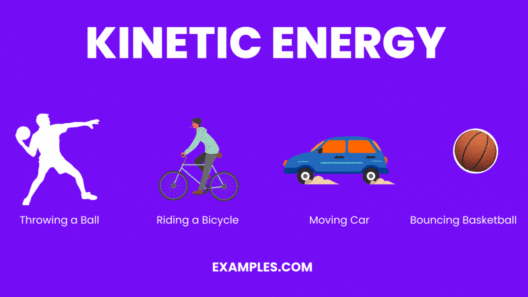
Moreover, even everyday observational phenomena relate to the interplay between mass and energy conservation. When a pendulum swings, it epitomizes energy transitions: potential energy at its apex transforms into kinetic energy at its nadir. However, the masses involved dictate the pendulum’s behavior, oscillation frequency, and energy profile. A heavier pendulum, for instance, will have more kinetic energy at its lowest point than a lighter one, demonstrating how mass intricately influences energy dynamics.
But mass does more than simply convert to energy; it also affects how energy is distributed and manifested in various systems. Take, for example, the concept of inertia. An object with substantial mass requires a greater amount of energy to change its state of motion than a lighter object. This concept has profound implications in engineering, transportation, and environmental considerations. Heavier vehicles consume more energy to accelerate and require more fuel over time, contributing to larger carbon footprints. Hence, understanding the mass-energy relationship becomes imperative for sustainable development.
The discourse around mass and energy conservation isn’t limited to physical systems. There are ecological systems where energy transformation occurs, illuminated through the lens of mass. Photosynthesis is a prime example: plants convert light energy into chemical energy, growing in mass as they accumulate biomass. The conservation principle reigns here as well; energy influx sustains growth and ultimately affects ecological balance. Conservation of mass and energy within ecosystems ties directly to carbon cycles and biodiversity, emphasizing the interconnectedness of these principles within environmental stewardship.
In tandem with these insights, the discourse upon mass effects the law of conservation leads naturally to considerations regarding sustainability. With the urgent climate crisis looming, a deeper comprehension of energy consumption across varying masses is pivotal. Technological advancements can enhance energy efficiency, but the awareness of mass impacts around energy use must also prevail. From urban planning that considers mass distribution in transportation networks to devising renewable energy technologies capable of converting mass to energy efficiently, these aspects ultimately dictate an eco-conscious trajectory.
In summary, one’s explorations of whether mass affects the Law of Conservation of Energy unfurl layers of complexity that impinge on every facet of both natural and engineered systems. The essence of mass is embedded within energy conservation principles, creating elaborate interdependencies manifesting through phenomena in the cosmos, engineering systems, and ecological frameworks. Observations of energy transformations, from the macroscopic grandeur of celestial occurrences to the minute details of everyday objects, reveal a perpetual dance of mass and energy in alignment with conservation laws. Acknowledging and embracing these interrelationships are essential, not only for scientific inquiry but also for the broader pursuit of sustainability in an ever-changing world.