
How Does Conservation of Energy Influence Roller Coasters? Physics on the Tracks
Have you ever pondered the exhilarating journey of a roller coaster as it swoops and soars through the air? Roller coasters provide thrill-seekers with fast-paced excitement, but the underlying principles that power these rides are steeped in the fascinating world of physics, particularly the conservation of energy. As we embark on this exploration, consider this playful question: How does a hefty drop translate into the sensation of weightlessness on a loop? To grasp this enigma, we must first dissect the relationship between energy, motion, and gravity within the context of roller coasters.
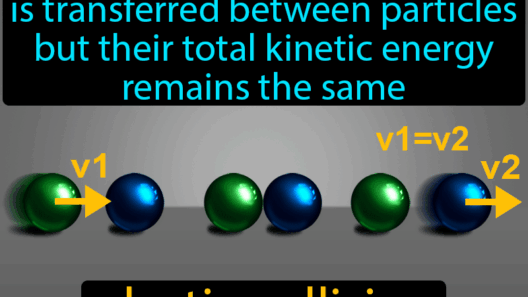
At the heart of roller coaster dynamics lies the fundamental principle of energy conservation, often articulated as the law of conservation of energy. This principle posits that energy cannot be created or destroyed; it can only change forms. In the context of roller coasters, gravitational potential energy and kinetic energy are two key players in this exhilarating spectacle.
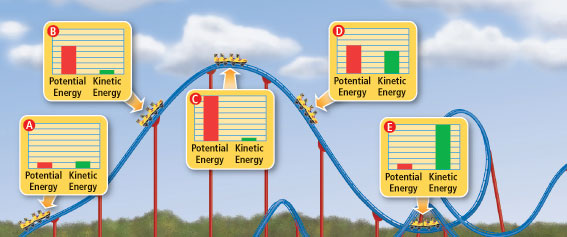
As the roller coaster ascends its initial hill, it accumulates gravitational potential energy. This energy is contingent upon the height of the hill and the mass of the train, expressed mathematically as PE = mgh, where “PE” represents potential energy, “m” denotes mass, “g” signifies the acceleration due to gravity, and “h” indicates height. Consequently, the higher the coaster climbs, the greater the potential energy it possesses at that zenith.
Once the peak is reached, a transformation occurs. The roller coaster begins its rapid descent, converting its stored gravitational potential energy into kinetic energy, the energy of motion, represented by the equation KE = 1/2 mv², where “KE” stands for kinetic energy, “m” for mass, and “v” for velocity. This is where the thrill of roller coasters truly manifests. As the coaster plummets downward, riders experience an exhilarating surge of speed and sensations, epitomizing the conversion of potential energy into kinetic energy. The sheer velocity can induce feelings of weightlessness, especially when traversing inversions or loops.
However, while the conversion of potential to kinetic energy is fundamental, other factors—such as friction and air resistance—come into play. These forces dissipate energy primarily as heat, underscoring the necessity for roller coaster engineers to design tracks that minimize energy loss while maximizing thrills. The friction between the coaster wheels and the rails can impede the smoothness of the ride, while air resistance can act as a brake during high-speed sections. Thus, while riders obtain a taste of gravity-defying thrills, engineers must carefully calibrate the design to ensure the coaster completes its journey safely.
Understanding these nuances brings us to the playful question that was posed: How do designers manage to maintain speed through a loop while ensuring rider safety? When a roller coaster enters a loop, both gravitational and centrifugal forces come into play. The forces exerted on the train and its riders change, creating a dynamic environment that requires meticulous design. Engineers calculate the ideal radius and angle of the loop to sustain a given velocity at the apex, ensuring that riders experience sufficient centripetal force without feeling the jarring effects of gravity overpowering the track.
Additionally, the principles of conservation of energy lead to innovative designs, such as the incorporation of magnetic propulsion systems and chain lifts. These systems enhance safety while keeping the adventure exhilarating. For example, magnetic launch coasters utilize electromagnetic forces, allowing for rapid acceleration without the traditional chain lift. This reduces reliance on gravitational energy alone, offering a unique twist on the traditional ride experience.
Moreover, the design also integrates environmental considerations. As an environmental consciousness grows, many amusement parks are shifting focus towards sustainability. By employing regenerative braking systems, roller coasters can convert some kinetic energy back into electrical energy, which can then be redirected for other uses in the park. This fusion of thrilling experiences and eco-friendliness represents a forward-thinking approach to amusement park design.
In reflecting on these layers of complexity, it is crucial to highlight the significance of education in nurturing a comprehensive understanding of physics in real-world applications. The intricate dance between potential and kinetic energy not only governs roller coaster dynamics but also serves as a lens through which we can observe the broader principles of energy conservation across various scientific fields. Each loop, drop, and twist can serve as a springboard for discussions about the laws that govern our universe.
In conclusion, roller coasters exemplify the captivating interplay between physics and thrill. As potential energy transforms into kinetic energy, riders embark on a journey that transcends mere entertainment; it is an observation of physics in action. While enjoying the weightlessness and breathless speeds, remember the engineers meticulously calculated every turn, ensuring safety while harmonizing with the core principles of energy conservation. So, the next time you board that coaster, consider not just the thrill but the underlying physics at play and the pressing challenge of making such creations sustainable in a warming world.