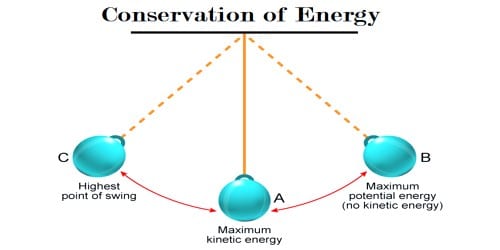

The phenomenon of a pendulum offers a captivating glimpse into the principles of energy conservation and transformation. The simple pendulum—a weight suspended from a fixed point that swings back and forth—serves as a quintessential illustration of mechanical energy in action. In exploring how energy conservation applies to a pendulum, one can unravel foundational concepts in physics while simultaneously appreciating the elegance of nature’s laws.
At its core, the pendulum reveals a fascinating interplay between potential energy and kinetic energy. When the pendulum is displaced from its equilibrium position, it is elevated to a certain height. In this state, the pendulum possesses gravitational potential energy. This energy is a function of its height above the ground and the mass of the bob. Specifically, potential energy (PE) can be quantified by the equation PE = mgh, where m represents mass, g denotes the acceleration due to gravity, and h is the height. Therefore, the higher the mass is lifted, the more potential energy it accrues.
As the pendulum swings away from its highest point, gravitational forces do work on it, converting potential energy into kinetic energy—the energy of motion. The kinetic energy (KE) of the bob can be expressed through the equation KE = 1/2 mv², where v is the velocity of the mass. As the pendulum descends, it accelerates due to the influence of gravity, causing its speed to increase and thus elevating its kinetic energy.
This transformative exchange from potential to kinetic energy occurs seamlessly, showcasing the conservation of mechanical energy within the system. In an ideal, frictionless world devoid of air resistance, the initial potential energy at the apex of the swing would equal the maximum kinetic energy as the bob passes through the lowest point of its trajectory. This principle—often distilled into the principle of conservation of energy—states that in an isolated system, total energy remains constant. Yet, real-world applications rarely present themselves in such pristine conditions.
In practical scenarios, dissipative forces, such as air resistance and friction in the pivot, introduce energy losses into the system. Each swing of the pendulum thus generates a tiny bit of heat, resulting in a gradual decrease in the amplitude of the swing over time. This gradual decline encapsulates the reality that while energy cannot be created or destroyed, it can be transformed into less useful forms. This aspect of energy efficiency calls for mindfulness in design and usage in various mechanical systems.
To delve deeper, consider the dynamics of the pendulum through its entire cycle. When the pendulum is at its highest point—known as the amplitude—its speed is momentarily zero, and all energy is in the form of potential energy. As it begins its descent, potential energy converts into kinetic energy. At the midpoint of the swing, the pendulum achieves its maximum velocity. Here, kinetic energy is at its peak while potential energy is at its nadir.
Upon reaching the lowest point and surging upward again, kinetic energy transforms back into potential energy. This elegant cycle persists, rhythmically oscillating between the two states, offering a physical representation of energy’s fluidity. The period of the pendulum—the time taken for one full cycle—is influenced by the length of the pendulum and the acceleration due to gravity, encapsulated in the formula T = 2π√(L/g), where T is the period and L is the length of the pendulum. This foundational relationship emphasizes how the pendulum’s structure directly impacts its dynamic behavior.
Moreover, the simplicity of a pendulum belies its multifaceted implications in broader scientific inquiries, including climate science and energy conservation efforts. The pendulum can inspire fresh perspectives on how we approach energy consumption and resources. Just as the pendulum continuously transforms energy forms, we can strive to enhance the efficiency of our energy use, pivoting towards sustainable practices that minimize waste and maximize utility.
In a world grappling with the accelerating impacts of climate change, embracing a conservation mindset—much like the pendulum’s energy transformations—can lead to meaningful shifts in behavior. Energy conservation is not simply about reducing use; rather, it is about optimizing the energy we do consume. By looking to nature and its principles, we begin to understand the delicate balance that underlies energy systems across the planet. The pendulum stands as a metaphor for our own energy practices, compelling us to examine how our actions can resonate with the principles of conservation, efficiency, and sustainability.
Ultimately, the physics of a pendulum invites curiosity and encourages a deeper understanding of the natural world. The seamless orchestration of energy transformation serves not only as a staple in classical physics but also as a symbol of balance and efficiency. By examining how energy flows within such an elegant system, we can glean insights that inspire profound systemic change. The pendulum, in its simple, rhythmic elegance, reveals an indispensable truth: every swing has the potential to educate, inspire, and transform our understanding of energy in the context of both science and sustainability.
Engaging with the concept of energy conservation through the lens of a pendulum fosters an appreciation for the interconnectedness of physical laws and environmental responsibility. As we recalibrate our approach to energy usage, let us envision a world where we mirror the pendulum’s capability to conserve and utilize energy wisely, ensuring a sustainable existence for generations to come.