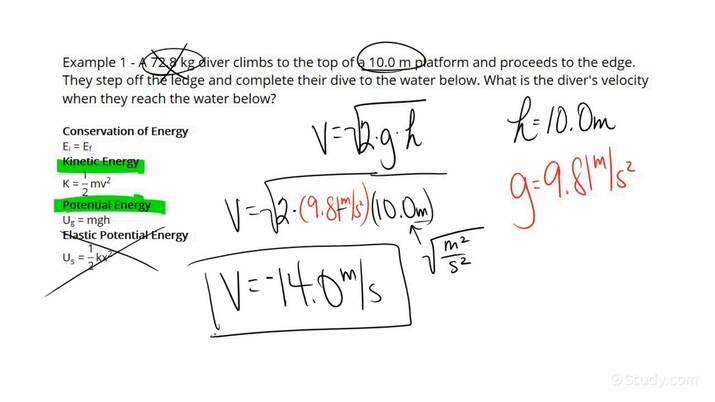

Understanding the relationship between energy and motion is fundamental in physics. By utilizing the principle of conservation of energy, we can deduce the velocity of an object under various conditions. This step-by-step tutorial will guide you through the process, illustrating how to derive velocity using kinetic and potential energy. As we delve deeper, definitions, equations, and types of energy will be explored, ensuring a comprehensive grasp of the topic.
To begin with, it is essential to comprehend the concept of energy in physics. Energy exists in several forms, with the most pertinent to our discussion being kinetic energy (KE) and potential energy (PE). Kinetic energy is the energy associated with the motion of an object, characterized mathematically by the equation:
KE = (1/2)mv²
Where m represents mass measured in kilograms, and v signifies velocity in meters per second. In contrast, potential energy refers to stored energy, depending on the object’s position and the force of gravity, given by the formula:
PE = mgh
Here, h is the height above a reference point, and g is the acceleration due to gravity, approximately 9.81 m/s² on Earth.
At the core of our exploration lies the principle of conservation of energy, which states that energy cannot be created or destroyed but only transformed from one form to another. When an object is influenced by gravity, as it moves between different heights, its potential energy converts into kinetic energy, and vice versa. This principle can be expressed in a simplistic form:
KE_initial + PE_initial = KE_final + PE_final
This equation underscores that the total mechanical energy remains constant in the absence of external forces, like friction.
Now, let’s walk through a practical scenario where this concept is employed to calculate velocity. Suppose you have a ball of mass m that is dropped from a height of h. At the top, the ball possesses potential energy, while upon reaching the ground, all that energy is converted to kinetic energy.
1. **Identify given values.** For the ball, we assume:
- m = 2 kg (mass of the ball)
- h = 10 m (height from which it is dropped)
2. **Calculate potential energy at the height.** Plugging in the values into the potential energy formula:
PE_initial = mgh = 2 kg × 9.81 m/s² × 10 m = 196.2 J
3. **Set initial potential energy equal to final kinetic energy.** As the ball falls, its PE is converted to KE when it hits the ground:
KE_final = PE_initial
Thus:
(1/2)mv² = 196.2 J
4. **Rearrange the equation to solve for velocity.** This step entails isolating v:
v² = (2 × KE_final) / m
Plugging in the values, we have:
v² = (2 × 196.2 J) / 2 kg = 196.2 m²/s²
5. **Calculate the square root to find v.** Taking the square root of both sides:
v = √196.2 m²/s² ≈ 14.0 m/s
The ball, upon reaching the ground, would have a velocity of approximately 14.0 m/s.
This example encapsulates a straightforward application of the conservation of energy, converting potential energy into kinetic energy to find velocity. Such principles can extend to various scenarios, including projectile motion and oscillations.
Notably, variations of this process exist, depending upon the scenario presented. For instance, consider a scenario involving horizontal motion, such as the launch of a projectile. When an object is propelled onto a parabolic trajectory, the interconversion between kinetic and potential energies follows the same foundational rules. This underlines the versatility of energy conservation across diverse physical applications.
Moreover, it is paramount to acknowledge that friction and air resistance may play a significant role in real-world situations. In academic problems, these forces are often omitted for simplicity; however, in practical applications, they must be accounted for. Analyzing the forces in such contexts can complicate the calculations but enriches the understanding of dynamic systems at play.
Finally, an essential aspect of understanding energy conservation encompasses the calculations’ limitations. Relying strictly on theoretical principles may overlook complexities found in actual environments. Factors such as rotational inertia, energy losses to air friction, and mechanical inefficiencies can significantly influence results. Thus, while the calculations provide a pragmatic approximation, empirical experimentation remains vital for verifying theoretical predictions.
In conclusion, utilizing energy conservation principles to find velocity illustrates a profound connection between motion and energy types. By understanding and following the outlined steps, one can effectively navigate a myriad of scenarios in physics involving energy transformation. Grasping these concepts not only enhances comprehension of mechanical systems but also lays the groundwork for exploring more intricate topics such as momentum and thermodynamics. All of these aspects converge to foster a richer understanding of the dynamic universe we inhabit.