
As the planet continues to warm, a pressing question arises: what happens when the organisms responsible for vector-borne diseases find their way into new territories? This query is particularly pertinent in the era of global warming, a phenomenon that inexorably alters ecosystems and human activities. An intricate web of interactions among climate, ecology, and human behavior orchestrates the movement of these pathogens, creating a precarious setting for public health. In considering this subject, we must embark upon an exploration of the complex relationships between global warming, the migratory patterns of vectors, and the implications for human health.
Vector-borne diseases, transmitted by organisms such as mosquitoes, ticks, and flies, constitute a formidable public health threat. As environmental temperatures rise, these vectors expand their ranges, encroaching on areas previously unhospitable. For example, studies indicate that warmer temperatures facilitate the proliferation of the Aedes aegypti mosquito, a notorious vector for diseases such as dengue fever, Zika virus, and chikungunya. As warmer climates emerge in regions like North America, Europe, and even parts of Asia, the potential for outbreaks of these maladies increases significantly.
The mechanics of vector movement can be attributed to a multitude of factors influenced by climate. Temperature is fundamentally critical; it dictates the metabolic rates of vectors and pathogens, thus affecting their reproduction rates, feeding behavior, and transmission dynamics. As average global temperatures rise, the lifecycle of vectors may accelerate, resulting in higher population densities. This escalating proliferation can create a feedback loop, where increased vector populations lead to a greater incidence of disease transmission. The interplay of humidity and precipitation also adds complexity. Increased rainfall creates breeding habitats for mosquitoes, further exacerbating the potential for disease transmission.
As intriguing as it may seem, the geographical shift of vectors poses an alarming challenge: how can public health systems adapt to these changing dynamics? In historic circumstances, emerging diseases were often met with reactive strategies—an approach that proves inadequate in the face of climate change. Continuous monitoring and proactive measures are paramount for mitigating risks. Surveillance programs must be implemented to track the movements of vectors and diseases in real time. This necessitates collaboration among various sectors including environmental science, public health, and community organizations.
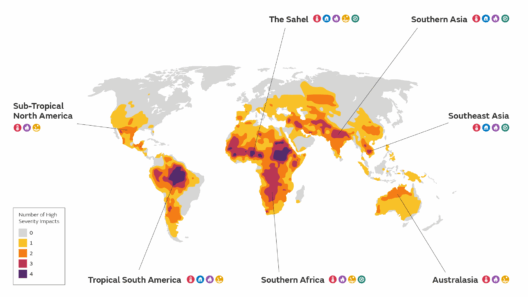
The burdens borne by under-resourced communities, particularly in developing nations, are exacerbated by the impacts of climate change. Global warming is not uniform; its effects vary by region, leaving vulnerable populations particularly exposed. Limited access to healthcare, infrastructure deficiencies, and socio-economic fragility amplify the risks associated with emerging vector-borne diseases. As these conditions worsen, a systematic approach tailored to the specific environmental and social context of communities is essential. Local knowledge and cultural practices must be integral components in devising public health interventions.
In light of these challenges, innovative strategies must be deployed to curb the potential suffering inflicted by vector-borne illnesses. One promising avenue is the implementation of Integrated Vector Management (IVM), which combines ecological methods, biological control, and social mobilization to manage vector populations sustainably. Education initiatives can also play a pivotal role, empowering communities to adopt preventive measures and respond to the threats posed by vectors effectively. This shift from reactionary to proactive strategies is crucial in the age of climate change.
Moreover, a multifaceted understanding of the interconnections between climate change and vector-borne diseases emphasizes the importance of global cooperation. The crux of the challenge lies not solely in addressing emerging diseases at a local level but in recognizing that public health is a global concern. Collaborative research, resource sharing, and coordinated responses can ensure that no region is left to fend for itself in the face of these escalating threats. This journey involves bridging scientific knowledge with international policy, creating robust frameworks for resiliency against the impending health crises.
What happens when communities are not equipped to confront this new reality? The ramifications extend far beyond immediate health concerns, influencing economic stability, social cohesion, and overall human development. As vector-borne diseases proliferate, we risk creating a world where illness and mortality are disproportionately concentrated in regions already grappled by poverty and instability.
In summation, the nexus of global warming and vector-borne diseases presents myriad challenges that require an urgent and multifaceted response. The transformation of vector habitats, the complexities of environmental interactions, and the socio-economic implications of disease prevalence must be acknowledged and addressed through a holistic lens. It is imperative that individuals, communities, and governments unite in proactive measures. By embracing innovative strategies, fostering education, and promoting international collaborations, humanity can adeptly navigate the turbulent waters ahead. The stakes are high, and the time for action is now.