

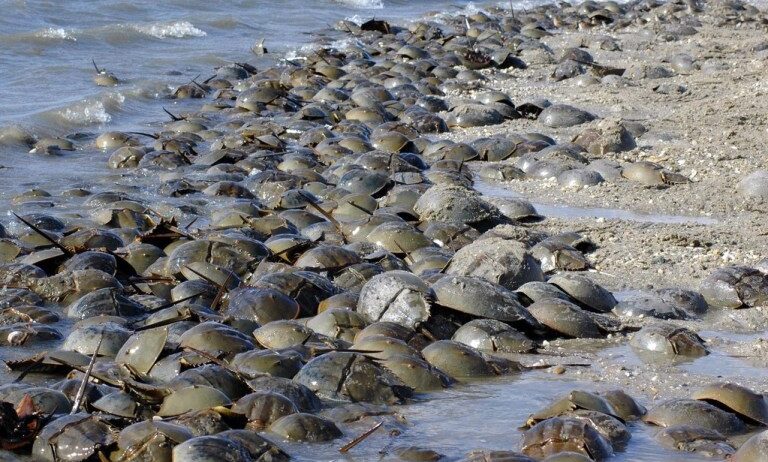

Imagine strolling along a tranquil beach, where the sun casts golden hues over the gentle waves. Suddenly, you stumble upon an intriguing creature: a horseshoe crab. These peculiar arthropods, often mistaken for true crabs, have existed for nearly 450 million years. But here’s a playful question for you: Can horseshoe crabs survive out of water? A simple answer might suffice, yet this query opens a Pandora’s box of fascinating survival facts and environmental considerations.
To embark on this exploration, one must first understand the biology of the horseshoe crab. Unlike typical crabs, horseshoe crabs belong to the class Merostomata. With their hard, exoskeletal shells and distinct tail spine, these creatures have survived unchanged through cataclysmic events that have decimated countless other species. Their evolutionary prowess evokes curiosity—how do they thrive in diverse environments, including life outside of water?
At the core of their ability to withstand limited terrestrial excursions is a remarkable adaptability to hypoxic conditions. While horseshoe crabs are marine animals, residing primarily in shallow coastal waters, they have an extraordinary respiratory system that allows them to absorb oxygen through both gills and skin. This evolutionary trait enables them to endure brief periods of aerial exposure, especially when they find themselves engaging in spawning activities on moist beaches during the spring tide.
However, there’s a catch: their survival out of water is notably finite. Horseshoe crabs depend upon a moist environment to prevent desiccation. Exposure to the sun’s radiant energy without the embrace of water can rapidly lead to lethargy and distress. Though they may manage to endure a few hours out of their aquatic realm, extended periods on dry land are detrimental to their well-being. Therefore, one must navigate the complexities of their habitat to comprehend the delicate balance required for their survival.
Interestingly, the hydrodynamic design of their bodies lends a hand in their limited terrestrial escapades. Their flattened carapace allows them to travel over sandy substrates with relative ease. During breeding seasons, female horseshoe crabs can often be seen trudging across sandy beaches, where they dig shallow pits to lay their eggs. The moisture retained in the sand is crucial at this juncture, as it aids the fertilized eggs’ development.
Nevertheless, it raises a pressing question: what environmental threats jeopardize these seemingly resilient creatures? Human activity has wrought significant changes to their habitat. Coastal development, pollution, and climate change collectively pose daunting challenges. As ocean temperatures rise and salinity levels fluctuate, the delicate ecosystems where horseshoe crabs thrive may deteriorate, consequently affecting their reproductive patterns and overall population dynamics.
The eggs laid in sandy nests are susceptible to predation by various species, but also more severe environmental changes. Those egg-laden environments are often exploited, leading to overharvesting or destruction of crucial coastal habitats. These factors emphasize the importance of habitat preservation to ensure that these ancient mariners continue their existence unimpeded.
The intersection of horseshoe crabs and medical science further highlights their value beyond mere ecological storytelling. Their blue blood, rich in a unique copper-based compound known as hemocyanin, has provided significant insights into the detection of bacterial endotoxins, vital for ensuring the safety of medical supplies. Consequently, horseshoe crabs have attained an inadvertent role in human health, with their survival becoming intrinsically tied to our own. Hence, the question of their survivability out of water transcends biology; it dives into realms of ethics and environmental stewardship.
In light of these multifaceted discussions, another inquiry emerges: how can we aid in the conservation of horseshoe crabs while respecting the balance of our marine ecosystems? Implementing sustainable fishing practices is paramount. By establishing protected breeding zones and fostering educational outreach, we can cultivate appreciation for these remarkable creatures. Moreover, the integration of community-led conservation initiatives can anchor genuine grassroots efforts, ensuring horseshoe crabs are safeguarded for future generations.
Furthermore, citizen science offers an innovative avenue for engagement. By enlisting the help of local communities in monitoring horseshoe crab populations, researchers not only gather important data but also foster a sense of ownership. This shared responsibility can enhance commitment to environmental protection, ultimately benefiting the entire ecosystem.
As we contemplate the idiosyncrasies of the horseshoe crab, it is vital to recognize that their existence is a testament to resilience and adaptation. Yet, the question remains: Can horseshoe crabs survive out of water? The answer lies not just in physiological resilience but also in understanding the broader environmental context. With impending climate challenges, their survival relies on collective efforts towards conservation and awareness.
Thus, as you walk along that fateful beach and encounter a horseshoe crab ambling on the sand, remember that you are witnessing the remarkable intersection of life’s fragility and endurance. Let this moment inspire action, so future generations may share in the wonder these ancient beings offer. With urgency, we must champion their cause and ensure that horseshoe crabs continue to thrive, both in water and on land, signaling a profound coexistence with our ever-changing world.