


In the realm of physics, the concept of conservative forces is pivotal in understanding energy conservation and mechanical systems. Conservative forces, by their definition, do not depend on the path taken; rather, they depend solely on the initial and final states of a system. Common examples of conservative forces include gravitational and elastic forces. An intriguing question arises when examining these forces: do conservative forces actually generate heat? This question taps into the core of thermodynamics and energy conservation, inviting deeper exploration into the behavior of systems influenced by conservative forces.
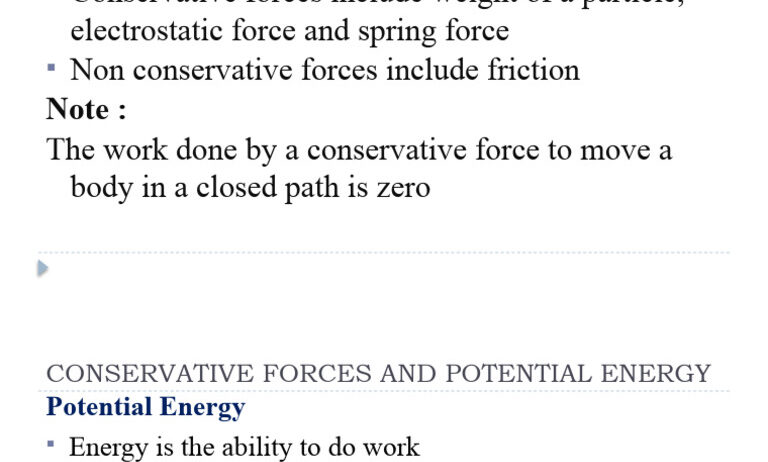
First, let us define what is meant by conservative forces. These forces possess a unique attribute: the work done by or against them is stored as potential energy, which can be fully recovered. For instance, when lifting an object against gravity, energy is stored in the form of gravitational potential energy. When the object is allowed to fall, this potential energy converts back into kinetic energy without any loss in an ideal situation. This principle of energy conservation serves as a foundation for many physical processes and is crucial in various applications ranging from engineering to environmental science.
To address the core question, it is essential to consider the nature of energy transformations. Conservative forces, by their idealistic nature, do not inherently generate heat. Instead, they proficiently convert energy from one form to another—primarily between kinetic and potential energy—without any dissipation into thermal energy within an isolated system. This characteristic distinguishes them from non-conservative forces, such as friction or air resistance, which inherently convert mechanical energy into thermal energy, manifesting as heat.
Conservative forces operate within the confines of a conservative system, which is characterized by its ability to return to its initial state. This mindset is crucial when evaluating energy within mechanical systems. For example, consider a mass on a spring. When compressed or stretched, the spring exerts a conservative force which stores mechanical energy. Upon release, the spring converts this stored energy back into motion without generating heat—assuming ideal conditions with no energy loss from the system.
However, the reality is rarely ideal. While conservative forces themselves do not generate heat, the systems that experience these forces often involve non-conservative elements that introduce energy dissipation. In practical scenarios, friction is ubiquitous. Even in a situation where conservative forces are the predominant actors, the presence of friction—an inherently non-conservative force—inevitably leads to energy loss, primarily in the form of heat. This interaction underscores a fundamental point: while conservative forces by themselves do not produce heat, their role within a system does not exist in isolation.
To illustrate this point further, consider a roller coaster. The ascent of the coaster represents work done against conservative gravitational forces, storing potential energy at the peak of a hill. As the coaster descends, this energy is converted back into kinetic energy. However, throughout the ride, friction between the coaster and the track, as well as air resistance, work against the motion. The effect of these non-conservative forces manifests as heat, dissipating energy that could otherwise perpetuate the mechanical motion of the coaster.
Moreover, one must also explore the implications of conservation of energy in real-world applications. Engineers and designers strive to minimize non-conservative forces in systems involving conservative forces to enhance efficiency. For instance, in mechanical systems such as pendulums or regenerative braking in electric vehicles, a balance is sought between maximizing potential and kinetic energy while minimizing losses to heat. This balance is a cornerstone of sustainable design practices, which heavily factor in energy conservation to promote the efficient use of resources.
Another compelling aspect of this discussion relates to the broader phenomenology of heat generation from work. In the context of thermodynamics, when work is done on a system, it can transform into different forms of energy. If a non-conservative action occurs post the interaction of conservative forces, such as compression of a gas in an engine, heat is produced. Here, the conservative nature of forces becomes intertwined with non-conservative elements leading to a synthesis that ultimately produces thermal energy—an essential consideration for thermodynamics and energy efficiency.
Ultimately, the relationship between conservative forces and heat generation is multi-layered. At its core, conservative forces do not produce heat. However, in practical, real-world scenarios, the presence of non-conservative forces complicates this dynamic. As energy is exchanged and transformed, the interplay of these forces most often leads to energy dissipation in the form of heat. This reality elicits deeper considerations regarding energy conservation, system efficiency, and the environmental implications associated with different energy transformations.
In pursuing a more sustainable future, understanding the nuances of force interactions and energy transformations becomes vital. By acknowledging the attributes of conservative forces alongside the inevitability of energy dissipation through non-conservative forces, individuals and organizations can work towards optimizing energy usage. This awareness fosters innovation in technology, paves the way for advances in energy conservation, and ultimately supports crucial conservation efforts that seek to minimize environmental impacts and enhance sustainability across various disciplines.