


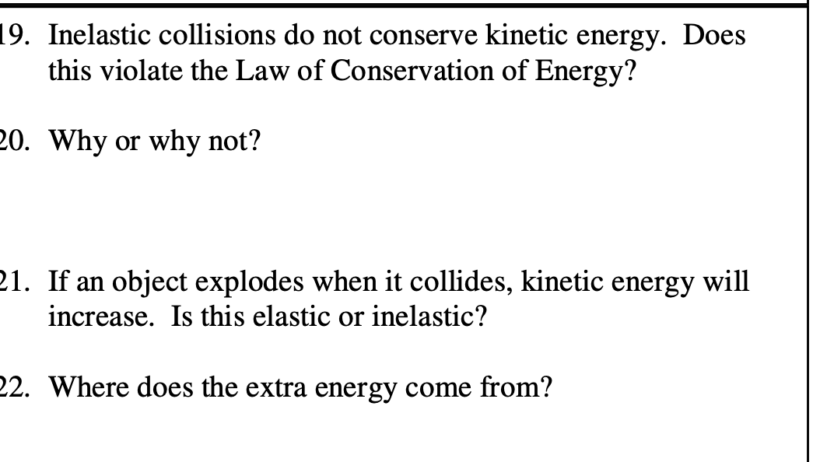

Inelastic collisions are a fundamental concept in classical physics, often discussed within the framework of momentum and energy conservation. These collisions are characterized by a distinctive trait: they do not conserve kinetic energy, a pivotal point that distinguishes them from elastic collisions. This article delves into the nature of inelastic collisions, their implications in real-world scenarios, and the physics principles at play, specifically kinetic energy and momentum conservation.
To understand the nuances of inelastic collisions, one must first solidify their grasp of what defines an elastic collision. In elastic collisions, both momentum and kinetic energy are conserved. This means that the total kinetic energy before the collision is equal to the total kinetic energy after the event. A classic example includes two billiard balls striking each other. However, when we venture into the territory of inelastic collisions, the rules shift dramatically.
Inelastic collisions occur when kinetic energy is not conserved due to the transformation of some of the kinetic energy into other forms of energy, such as thermal energy, sound, or deformation. A quintessential example is that of a car crash; cars crumple upon impact, absorbing energy, which is dissipated as heat and sound. This illustrates how the kinetic energy is transformed rather than preserved.
There exists a category of inelastic collisions known as perfectly inelastic collisions, where the colliding objects stick together post-collision. This scenario marks the extreme case of inelastic interactions. For instance, if two Play-Doh balls collide and adhere to each other, they move as a joined mass. In this instance, the calculation of kinetic energy becomes even more complex, as the energy transformation accounts for the total inelastic deformation and other forms of energy release during the interaction.
Now, let’s consider the mathematical aspect of kinetic energy in the context of inelastic collisions. Kinetic energy (KE) is expressed by the formula KE = ½ mv², where m denotes mass and v represents velocity. Before a collision, the total kinetic energy can be calculated based on the velocities and masses of the two colliding bodies. However, after the collision, particularly in perfectly inelastic collisions, the velocity of the combined mass must be determined using the conservation of momentum, expressed as m₁v₁ + m₂v₂ = (m₁ + m₂)v, where m₁ and m₂ are the masses, and v₁ and v₂ are their respective velocities prior to the collision.
After obtaining the final velocity post-collision, one can compute the new kinetic energy of the combined mass. What becomes evident through this analysis is that the kinetic energy after the collision is less than the sum of the kinetic energies before the event. The disparity in kinetic energy highlights the energy that has been irreversibly transformed into another form of energy during the collision.
Understanding the conservation of momentum is equally crucial when analyzing inelastic collisions. Momentum, unlike kinetic energy, is always conserved in both elastic and inelastic collisions, provided no external forces interfere. In the momentum equation cited earlier, if one knows the masses and initial velocities of the involved bodies, the final velocity can be successfully determined. This conservation principle underpins many practical applications, from vehicular safety designs to assessing collision scenarios in sports physics.
In practical terms, inelastic collisions are ubiquitous in our world, affecting diverse domains from vehicle safety engineering to the design of sports equipment. For instance, the crumple zones in cars are meticulously engineered to manage the energy during a collision, maximizing the dissipation of kinetic energy and thereby reducing the energy transferred to the occupants. This engineering marvel illustrates how the principles of inelastic collisions translate into tangible safety protocols.
Moreover, inelastic collisions are responsible for a plethora of phenomena in nature. From molecular collisions in gases to macroscopic events like meteor impacts, the principles governing inelastic collisions offer insights into energy transformation processes. A meteor colliding with Earth, for instance, converts kinetic energy into thermal energy, leading to localized heating and, in extreme cases, vaporization of materials. The aftermath of such events expands our understanding of planetary science and energy conservation in celestial dynamics.
To further elucidate the characteristics of inelastic collisions, one can also examine real-world experiments that embody these principles. Utilizing simple apparatus such as marbles, one can observe both elastic and inelastic collisions. By measuring initial and final velocities, conducting comprehensive energy calculations highlights the distinct behaviors manifested within inelastic collisions. Such experimental investigations allow learners to tangibly grasp the theoretical concepts previously discussed.
In summary, inelastic collisions represent an intriguing aspect of classical mechanics where kinetic energy is not conserved, contrasting sharply with elastic collisions. The distinction arises from the transformation of kinetic energy into other forms during the collision process, most notably during perfectly inelastic interactions. Moreover, understanding inelastic collisions contributes to practical advancements in technology and safety in our everyday lives. Finally, acknowledging the fundamental differences between kinetic energy and momentum allows for a more nuanced insight into the mechanics of collisions and energy transformations, broadening our awareness and appreciation of physics in action.