

Global warming is often merely equated with a rise in temperature. Yet, this simplistic understanding belies a far more intricate and multifaceted issue at hand. As the globe inexorably warms, myriad consequences ripple through ecosystems, economies, and societies worldwide. This article endeavors to elucidate the depth and breadth of global warming’s impact, inviting a recalibration of our perspective on this pressing phenomenon.
The most apparent consequence of climate change is the escalation of average temperatures. Over the last century, global temperatures have increased markedly due to anthropogenic factors, predominantly the emissions of greenhouse gases. This contentious rise results from industrial activity, deforestation, and agricultural practices that release carbon dioxide, methane, and other harmful substances into the atmosphere. While a few degrees may seem trivial, the ramifications are profound—for instance, a mere two-degree increase can lead to catastrophic shifts within climatic patterns, affecting precipitation, ice melt, and sea levels.
Moreover, warmer temperatures are but the tip of the iceberg. The resultant climatic instability is a complex web of challenges that includes intensified weather events. Consider hurricanes; as ocean temperatures rise, these storms gather strength, resulting in increased precipitation and stronger winds. The destruction wrought by Hurricane Katrina in 2005 and Hurricane Sandy in 2012 underscores the catastrophic potential of such phenomena, leading to widespread devastation and disruptions in livelihoods. In essence, warmer temperatures serve as a catalyst for more volatile weather patterns that can wreak havoc across regions, irrespective of geographical location.
The relationship between global warming and hydrology cannot be understated. As temperatures rise, the hydrological cycle experiences disruptions, leading to altered rainfall patterns. This alteration manifests as excessive downpours in some areas while provoking droughts in others. The implications are dire; agricultural sectors face the dual threat of crop failures due to either flooding or insufficient water resources. Countries with arid climates are particularly vulnerable, as agricultural dependence on consistent weather renders them increasingly susceptible to food insecurity.
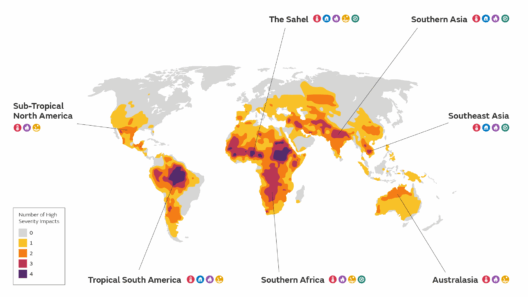
Furthermore, freshwater resources are diminishing as glaciers and snowpacks—the planet’s natural reservoirs—shrink in size. The consequences extend beyond immediate water shortages; these changes jeopardize entire ecosystems. Aquatic species, accustomed to stable temperature gradients and seasonal water flows, struggle to adapt to the rapid fluctuations, leading to biodiversity erosion. Additionally, entire communities reliant on these water supplies face existential threats, as witnessed by the ongoing crises in regions like the Southwestern United States and parts of sub-Saharan Africa.
Another critical aspect to consider is the relationship between global warming and public health. The fluctuation of temperatures opens the door for the proliferation of vector-borne diseases, such as malaria and dengue fever. Warmer environments create fertile breeding grounds for mosquitoes, leading to increased transmission rates. In urban settings, heatwaves become more pronounced, significantly affecting vulnerable populations, particularly the elderly and those with preexisting health conditions. Air quality also becomes compromised, exacerbating respiratory ailments as air pollutants interact with higher temperatures.
The economic implications of global warming are vast and varied. Coastal cities, grappling with rising sea levels, confront the risk of inundation. Real estate markets are challenged as properties in vulnerable areas face plummeting values. Infrastructure designed with historical climate data may no longer be adequate, prompting a costly overhaul in urban planning. Additionally, industries reliant on natural resources, like agriculture, fisheries, and forestry, face disruption as climate conditions shift dramatically. Such uncertainty breeds economic instability, impacting global markets and individual livelihoods alike.
Yet the conversation must extend beyond immediate consequences. Global warming engenders sociopolitical tensions that could alter geopolitical landscapes. Resource scarcity, driven by climate change, can lead to heightened competition for freshwater and arable land. Human displacement, termed climate migration, poses unique challenges as populations flee inhospitable environments, straining urban centers unprepared to receive sudden influxes. History bears witness to conflicts ignited by dwindling resources, suggesting that without proactive measures, climate-related strife may escalate.
However, recognizing the multi-dimensional consequences of climate change does not lead us into despair; rather, it spurs action. Understanding that global warming encompasses more than mere temperature increases ignites a sense of urgency to act. Mitigation strategies, such as renewable energy adoption, reforestation, and sustainable agricultural practices, present not only avenues to combat climate change but also opportunities for innovation and economic growth.
Moreover, transitioning to a sustainable economy fosters resilience against the myriad impacts of climate change. Investment in infrastructure, public health, and education can serve as a bulwark against the challenges posed by a warming world. By prioritizing sustainable approaches, communities can better weather the climactic storms looming on the horizon.
In conclusion, global warming transcends the narrow scope of increased temperatures. Its tapestry weaves through myriad factors, each interlaced and interconnected, impacting our ecosystems, economies, and social frameworks. To confront this challenge, we must adopt a holistic understanding, recognizing the urgency of mitigating its effects while fostering adaptive strategies to enhance resilience. The call to action beckons not just for awareness, but for transformative change across multiple sectors—a collective endeavor to safeguard the future we inhabit.