

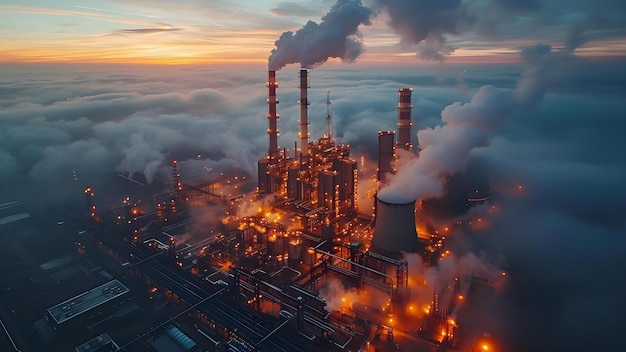

Factories and power plants are integral components of modern society, providing essential goods and energy that fuel our daily lives. However, this industrial activity is deeply intertwined with one of the most pressing challenges of our era: global warming. The industrial footprint is extensive, as it encompasses the emissions of carbon dioxide (CO2) and other greenhouse gases (GHGs) contributing to climate change. Understanding how factories and power plants contribute to global warming involves an examination of their operations, energy sources, and the systemic structures that support their existence.
At the heart of industrial emissions lies the combustion of fossil fuels. Factories and power plants, particularly those reliant on coal, oil, and natural gas, release vast amounts of CO2 into the atmosphere. The process is as follows: fossil fuels undergo combustion, generating energy, while byproducts such as carbon dioxide are expelled as waste. This CO2—notoriously known for its role as a greenhouse gas—traps heat in the atmosphere, thus exacerbating global warming. In fact, the energy sector alone accounts for a significant proportion of global CO2 emissions, highlighting its pivotal role in climate dynamics.
Moreover, the manufacturing processes within factories often rely on methods that are inherently energy-intensive. The production of goods such as cement, steel, and plastics involves high-temperature processes that necessitate substantial energy input. Each stage of manufacturing may contribute exponentially to the cumulative GHG emissions. For example, cement production is estimated to generate over 7% of global emissions. This staggering statistic brings to light the environmental costs of seemingly ubiquitous materials, illustrating a hidden yet profound impact on our climate system.
Additionally, factories contribute to global warming not only through emissions but also by utilizing significant quantities of energy generated from fossil fuels. While some manufacturers are transitioning toward renewable energy sources, many still depend on non-renewable energy to power their operations. The reliance on these energy sources stems primarily from economic considerations and the established infrastructure. Transitioning to renewable sources requires substantial investment, often leading to a hesitant shift in practices that perpetuates existing environmental harm.
Factories contribute to other greenhouse gases as well. In addition to CO2, various industrial processes release methane (CH4) and nitrous oxide (N2O), both of which possess a much higher heat-trapping potential than carbon dioxide, despite their lower atmospheric concentrations. For example, agricultural practices associated with factory farming and the industrial production of fertilizers release formidable quantities of methane and nitrous oxide, thus intensifying the greenhouse effect.
The inefficiencies of resource consumption within factories also amplify their environmental impact. Many industrial operations operate without regard for energy efficiency or waste minimization, leading to excessive consumption and waste generation. This inefficiency not only contributes to GHG emissions but also imposes unnecessary strain on resources such as water and raw materials. When industries discard waste products, landfills and open burning often become the end solution, further contributing to atmospheric pollution and the greenhouse gas emissivity associated with those practices.
The physical footprint of factories and power plants further complicates the matter of climate change. Industrial sites often occupy vast areas of land, which can disrupt local ecosystems and reduce biodiversity. In some instances, the removal of vegetation to make way for industrial facilities diminishes the planet’s capacity to absorb CO2, thereby exacerbating the rising levels of this greenhouse gas in the atmosphere. The installation of extensive industrial infrastructure also leads to urban heat islands, raising local temperatures and contributing to the broader phenomenon of global warming.
Public perception towards factories and power plants is often shaped by their immediate contributions to employment and economic growth. However, these benefits must be weighed against the long-term consequences associated with industrial pollution. Industries are often placed under scrutiny for their environmental policies, or lack thereof. While some corporations have begun to embrace sustainable practices—such as carbon offset programs, investment in greener technologies, and enhanced energy efficiency—others lag behind, prompted only by regulatory pressures rather than genuine concern for environmental stewardship.
Moreover, the global nature of industry compounds the environmental challenge. Goods produced in one part of the world may be consumed in another, resulting in a complex web of emissions associated with transportation, production, and disposal. This globalization of industry often leads to a lack of accountability, as emissions may be displaced to countries with less stringent regulatory frameworks. Consequently, the responsibility for industrial emissions can become obscured, complicating efforts to address the root causes of global warming clearly.
In conclusion, factories and power plants are significant contributors to global warming due to their operational reliance on fossil fuels, energy-intensive manufacturing processes, and inefficiencies in resource consumption. The multifaceted nature of industrial emissions—from carbon dioxide to methane and nitrous oxide—renders them a critical focus in the fight against climate change. As societies navigate the imperative of sustainable development, it is essential to confront the industrial footprint and implement comprehensive strategies that prioritize environmental integrity alongside economic progress. Only through concerted action and commitment to transformative practices can a path to a sustainable future be forged, mitigating the detrimental effects of global warming.