
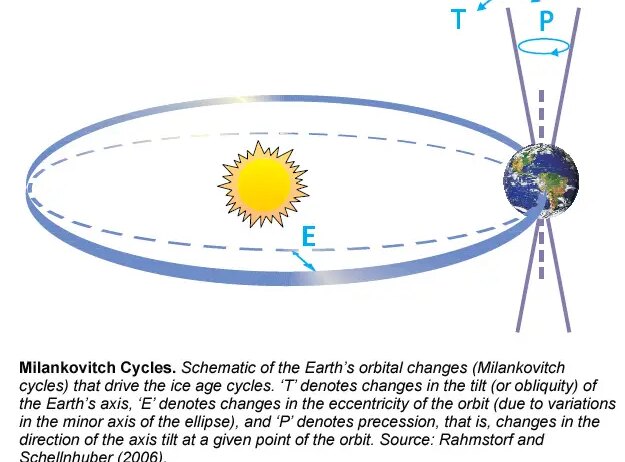

The intricate ballet of celestial mechanics constantly influences Earth’s climate. One of the most significant elements is the Earth’s axial tilt, commonly referred to as obliquity, which is one of the pivotal components of the Milankovitch Cycles. These cycles consist of long-term variations in Earth’s orbit and tilt that have profound impacts on global climatic patterns, including the potential for global warming.
To comprehend the connection between Earth’s tilt and these cycles, one must first understand the Milankovitch Cycles themselves. Named after Serbian mathematician Milutin Milanković, these cycles comprise three main components: eccentricity, axial tilt (obliquity), and precession. Eccentricity refers to the shape of Earth’s orbit around the sun, which varies from a circular to an elliptical shape over roughly 100,000 years. Axial tilt pertains to the angle of Earth’s axis relative to its orbital plane, fluctuating between 22.1 and 24.5 degrees over a period of approximately 41,000 years. Precession describes the gradual wobble of Earth’s axis, which affects the timing of the seasons and occurs over a cycle of about 26,000 years.
These cyclical phenomena have profound implications for Earth’s climate. As the axial tilt changes, it alters the distribution and intensity of sunlight received by different parts of the Earth. When the tilt is at its maximum (around 24.5 degrees), the summers are warmer and the winters colder in the respective hemispheres. Conversely, when the tilt is minimal (about 22.1 degrees), the seasonal contrasts are reduced, leading to cooler summers and milder winters. This undulatory pattern can create significant climatic shifts over millennia, thus precipitating phases of glaciation and interglacial periods.
During periods of heightened axial tilt, warmer summers may induce increased melting of glaciers and polar ice, culminating in higher sea levels. This melting contributes to a feedback loop; as less solar energy is reflected away from the dark ocean waters, more heat is absorbed, further exacerbating warming. Contemporary global warming, exacerbated by anthropogenic emissions, is interwoven with these natural cycles. Modern civilization now finds itself in a climate reality where human activity is drastically hastening the effects that these cycles would typically take thousands of years to manifest.
In addition to axial tilt and its seasonal impacts, eccentricity amplifies these effects significantly. The variations in the shape of Earth’s orbit change the distance from the sun, which in turn influences the Earth’s temperature. These changes can modulate the intensity of solar radiation received, thus impacting both short and long-term climate trends. During periods of high eccentricity, while the axial tilt is also pronounced, summers can reach extreme thermal peaks, leading to more pronounced polar melting and subsequent global temperature rises.
Furthermore, precession influences the timing and distribution of solar energy. As the planet wobbles on its axis, it modifies the alignment of Earth’s hemispheres with respect to the sun, causing seasonal timing shifts. Such alterations can have a profound impact on ecosystems and weather patterns. For example, when precession aligns with increased tilt and eccentricity, the sum effects can lead to significantly warmer climatic conditions during what was traditionally winter or cooler seasons, leading to shifts in biodiversity, agricultural productivity, and overall ecosystem stability.
It is essential to recognize the interconnectedness of these cycles with current climate phenomenon. While Milankovitch Cycles operate over geological timescales, today’s anthropogenic activities—primarily the release of greenhouse gases—are compounding natural cycles. The increased levels of carbon dioxide and methane in the atmosphere are enhancing the greenhouse effect, trapping heat and leading to rapid temperature increases. The interplay between natural climate processes and human-induced changes complicates our understanding of long-term climate trends.
As the world faces unprecedented changes, an understanding of Milankovitch Cycles provides critical context for the present climate crisis. For instance, during the last interglacial period, when the Earth experienced enhanced axial tilt and precession towards the Northern Hemisphere, global temperatures were significantly higher than today. Lessons from these historical shifts highlight the need to examine not just the current data but to draw on past climatic phenomena as a framework to predict future conditions.
In conclusion, the effects of Earth’s tilt and the Milankovitch Cycles profoundly shape global climate patterns. Their intricate interactions can lead to significant climatic shifts over thousands of years, impacting glacial cycles, sea levels, and ecosystem dynamics. As global warming accelerates due to human activity, recognizing the ramifications of these natural cycles becomes paramount in developing strategies to mitigate climate change. Understanding how these fundamental processes operate alongside anthropogenic factors is crucial for forming a holistic view of Earth’s climatic future.
Moving forward, it is essential for policymakers, scientists, and the public to engage with this understanding. Solutions to climate change, encompassing both mitigation of human impacts and adaptation to reinforced natural patterns, are needed to navigate the multifaceted challenges posed by a warming planet. The ongoing dialogue concerning climate action must integrate the insights offered by natural climatic cycles, emphasizing the urgency of our response to the shifting environmental landscape.