


Have you ever pondered how a mere push on a bicycle pump can inflate a tire? Or how hydraulic machines function so effortlessly, lifting heavy weights with minimal effort? This phenomenon can be understood through Pascal’s Law, a fundamental principle of fluid mechanics. The potential challenge lies in unraveling the intricate relationship between Pascal’s Law and the broad concept of energy conservation.
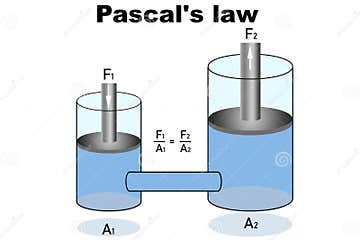
To begin, let’s delve into the essence of Pascal’s Law. Formulated by the French mathematician Blaise Pascal in the 17th century, this law states that when pressure is applied to a confined fluid, the pressure change is transmitted equally throughout the fluid in all directions. The underlying implication of this principle is profound: it allows for the efficient transmission of force through fluids, rendering various hydraulic systems functional.
Consider a hydraulic lift system, such as those found in automotive repair shops. When a small force is applied to a pump handle, this force generates pressure in the fluid, which then propagates through the fluid-filled pipes to the lift. This pressure results in an amplified force at the other end, enabling the lift to raise heavy vehicles with relative ease. But how does this amplification occur without violating the conservation of energy?
At the crux of this question is the idea of energy conservation, a fundamental principle in physics asserting that energy cannot be created or destroyed. Instead, it transforms from one form to another. When pressure is applied to a hydraulic system, work is done on the fluid. The work imparted to the fluid translates into pressure energy. In a closed system, this energy is conserved; thus, the input energy is equal to the output energy, albeit with a difference in force and displacement.
In hydraulic systems, the force exerted at the pump (input) and the resultant force at the actuating piston (output) can be expressed mathematically. According to the principle of conservation of energy:
Input Work = Output Work
Where:
- Input Work = Input Force × Input Distance
- Output Work = Output Force × Output Distance
It becomes apparent that while force increases at the output, the distance through which the output force acts decreases. This trade-off is critical; the output force is potent, but it operates over a shorter distance compared to the initial force. Hence, even though the output might be ten times the input force, it will act over a smaller distance, maintaining the equality of work done in the system.
This elegant interplay between force and distance in hydraulic systems can be beautifully illustrated through A Fluid Power System, employing incompressible fluids. The incompressibility of fluids is key. When pressure is applied to a fluid, it does not compress significantly; thus, the fluid can effectively transmit the applied force over long distances with minimal loss of energy.
However, this leads us to a playful question: what happens if air is used instead of a liquid in such systems? Would it be capable of transmitting force similar to water? The answer lies in the properties of gases versus liquids. While gases are compressible, fluids such as oil or water display incompressibility, allowing Pascal’s Law to manifest effectively. In a gas, an input pressure change would not translate equally throughout because the gas would compress rather than transmit the pressure uniformly. Thus, the efficiency of hydraulic systems relies on the unique properties of the chosen fluid.
The implications of Pascal’s Law extend far beyond mechanisms like automotive lifts. It applies to a wide array of technologies that drive our modern world, including aircraft control systems, brake systems in vehicles, and even the humble dentist’s chair. All of these systems hinge on the ability of fluids to transmit forces reliably, embodying Pascal’s Law in their operation.
Moreover, the interdependence of Pascal’s Law and energy conservation is not solely theoretical; it presents practical significance in various engineering applications. Engineers design hydraulic systems with this relationship in mind, optimizing them to minimize energy loss and enhance performance. The design considerations include careful selection of fluid types, dimensions of pipes, and cylinder ratios to maximize efficiency.
As we further explore the implications of Pascal’s Law, we might consider broader environmental perspectives. The design of hydraulic systems often incorporates renewable energy sources. By harnessing the principles of fluid mechanics and energy conservation, engineers can innovate processes that minimize energy consumption and reduce reliance on fossil fuels. This presents an exciting challenge in the quest to combat climate change; how can Pascal’s Law inspire innovative solutions that align with sustainability goals?
In conclusion, the connection between Pascal’s Law and the conservation of energy embodies a fascinating aspect of physical principles that govern our world. This intimate relationship reinforces the notion that energy transformation, rather than creation or annihilation, allows for the intricate functionality we observe in hydraulic systems. The driving forces of efficiency exemplified by this principle not only enhance our technological capabilities but also provoke considerations for sustainable practices in engineering. As we look to the future, the challenge lies in leveraging these principles to design solutions that are not only effective but also environmentally responsible.