


Have you ever pondered the transformative power of elastic potential energy in your daily routine? Imagine, for instance, that you are bouncing on a trampoline or drawing back a bowstring. Both activities harness the very principle of conservation of elastic potential energy. This concept, while fundamental in the realm of physics, extends its influence in a multitude of practical applications, making our lives more efficient, sustainable, and enjoyable. How can we effectively utilize this principle in real-life scenarios? Let’s explore several avenues through which elastic potential energy can be harnessed and conserved.
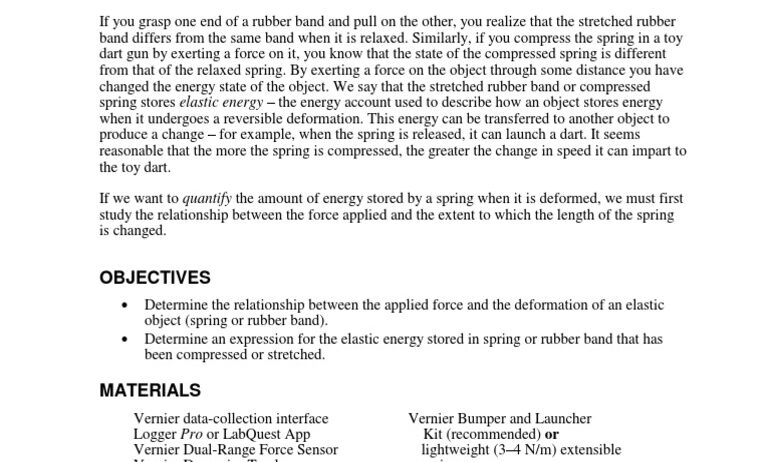
At its core, elastic potential energy is the energy stored within elastic objects when they are deformed. A simple example is a spring; when compressed or stretched, it stores energy that can be released to do work. The conservation principle states that energy cannot be created or destroyed, only transformed. In practical terms, this means that the energy exerted in stretching a bowstring, for instance, will be converted into kinetic energy when the string is released, propelling the arrow forward.
When exploring the implications of using elastic potential energy, one cannot overlook its application in mechanical systems. Vehicles, for example, can benefit from advanced suspension systems that incorporate elastic components like coil springs. These systems absorb shock and provide a smoother ride by converting the energy from bumps in the road into elastic potential energy, which is then released to stabilize the vehicle. The ongoing research in automotive engineering seeks to optimize this interplay, enhancing fuel efficiency and driving experience.
Another intriguing application is found in athletic equipment. Equipment such as racquets, bats, and bows have all undergone rigorous development to capitalize on elastic potential energy. When a player swings a racquet, the strings flex and store energy. The more efficient the energy transfer, the greater the potential for enhanced performance. Athletes benefit directly from these innovations, as they allow for improved accuracy and power with less exertion. Consider the challenge of finding the perfect balance; the right tension in the strings can make or break performance, leading to further research and experimentation.
In the realm of renewable energy, elastic potential energy plays a role in technologies designed to harness kinetic energy from waves or tides. These devices utilize materials that can bend and twist, capturing the energy produced by oceanic movements. As wave energy is harnessed and stored, it can be converted to electrical energy. This method not only promotes the conservation of energy but also reduces dependency on fossil fuels—addressing one of the pressing challenges of climate change.
Furthermore, elastic potential energy is pivotal in everyday household applications. For instance, rubber bands and children’s toys utilize this energy principle in a myriad of ways. When stretched, rubber bands store energy. Upon release, they send small objects flying. The playful question arises—how many creative uses can one devise for something as simple as a rubber band? It is a reminder of the need to rethink everyday materials and their potential applications. Encouraging children to explore these concepts fosters a connection to physics and engineering.
Moreover, the application of elastic potential energy extends to housing and architecture. Innovative designs have integrated elastic materials into structures to enhance resilience during natural disasters. Buildings engineered to flex may withstand earthquakes better than traditional designs, effectively conserving energy in chaotic environments. This creative use of elastic potential energy can ultimately save lives, underscoring the importance of conservation in humane progress.
On a larger scale, furniture design has also benefited from an understanding of elastic potential energy. Sofas and mattresses that utilize elastic components can enhance comfort and support while conserving energy. These designs leverage body weight to compress and then return to their original shape, maintaining durability and structural integrity. However, consumers face the challenge of distinguishing which products truly incorporate these principles versus those that do not, highlighting the need for more transparent information from manufacturers.
As we delve deeper into renewable energy solutions, the role of elastic potential energy in energy storage systems becomes paramount. Technologies such as flywheels use elastic components to store energy efficiently as rotational kinetic energy. This approach not only conserves energy but also promotes stabilization in electrical grids, balancing supply and demand. The challenge here is ensuring that these systems are both efficient and economically feasible for widespread adoption, a barrier that researchers are tirelessly working to overcome.
In the realm of education, it is crucial to illuminate the principles behind elastic potential energy to inspire future innovators and problem-solvers. Simple experiments involving springs or rubber bands can demonstrate these concepts in a tangible manner, paving the way for young minds to pursue paths in physics, engineering, and environmental science. Establishing curricula that emphasize the conservation of energy principles is essential to preparing the next generation for the challenges ahead.
Ultimately, the significance of elastic potential energy in practical applications cannot be overstated. From enhancing daily activities to influencing large-scale engineering practices, harnessing and conserving this energy contribute to a sustainable future. Reflecting on the inherent potential of everyday materials and the scientific principles that govern them allows society to navigate environmental challenges more effectively. Thus, the question becomes not just how to utilize elastic potential energy but also how to innovate continually, ensuring that our methods are sustainable, efficient, and beneficial. The exploration opens up a realm of possibilities that can inspire creativity, foster progress, and safeguard our planet for generations to come.