


Imagine two vehicles colliding in an accident. What happens to their kinetic energy? Does it simply disappear into thin air, or does it transform into another form? This tantalizing question leads us into the realm of perfectly inelastic collisions, a fundamental concept in physics and often showcased in discussions about conservation laws.
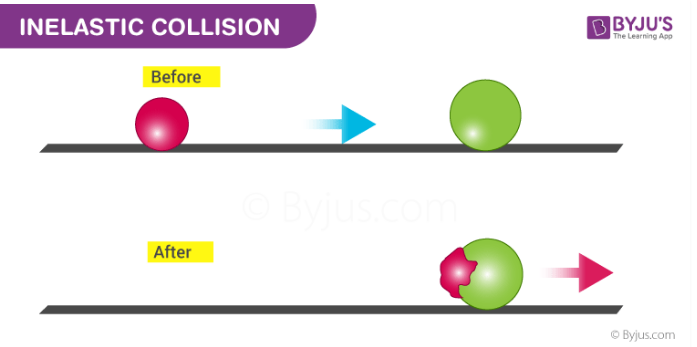
To unravel the mysteries surrounding this physical phenomenon, we first need to comprehend what a perfectly inelastic collision entails. In the simplest terms, a perfectly inelastic collision occurs when two objects collide and then move together as a single entity post-collision. This type of collision is characterized by the maximum loss of kinetic energy and maximal adhesion between the colliding bodies.
In such interactions, momentum is always conserved. The principle of momentum conservation is steadfast and applies universally, regardless of the specifics of the collision. Mathematically, if we denote the masses of two colliding objects as (m_1) and (m_2), and their initial velocities as (u_1) and (u_2), the total momentum before the collision can be expressed as:
(P_{initial} = m_1u_1 + m_2u_2)
After the collision, let (v) be the common velocity of the two objects. The total momentum post-collision is expressed as:
(P_{final} = (m_1 + m_2)v
Setting these equal gives us:
(m_1u_1 + m_2u_2 = (m_1 + m_2)v)
From this, we can solve for the final velocity of the two masses after they collide. What is crucial to note here is that while momentum is conserved, kinetic energy does not share that fortune in a perfectly inelastic collision.
To grasp why kinetic energy is not conserved, let’s delve into the concept of energy transformations. Kinetic energy, denoted as (KE = frac{1}{2}mv^2), is the energy that an object possesses due to its motion. In a perfectly inelastic collision, a significant portion of the initial kinetic energy is transformed into other forms of energy, such as thermal energy, sound energy, and potential energy associated with deformation of the involved objects.
Consider this scenario: Two cars collide, crumpling their metal frames and producing a loud sound. The kinetic energy before the collision is higher as the cars approach their point of impact at substantial speeds. However, post-collision, some of that energy is dissipated as heat in the bent metal and the noise generated during the crash. Thus, while the vehicles may still possess some kinetic energy after the collision—by virtue of their combined motion—the total kinetic energy remaining is less than it was prior to impact.
This leads us to the principle of conservation of energy, which posits that energy cannot be created or destroyed, only transformed from one form to another. In the context of a perfectly inelastic collision, the kinetic energy present in the moving bodies before the collision is not lost but converted into other forms. Hence, if we assess the energy state before and after the collision, we find that energy as a whole is conserved, but kinetic energy specifically is not.
Can we challenge the notion of an entirely energy-conserved universe when faced with inelastic collisions? While the principle of conservation of momentum stands firm, the specific kinetic transformation during these collisions illustrates a pivotal distinction between different types of energy conservation. Consequently, inelastic collisions serve as an excellent educational juncture from which students can explore nuanced principles, drawing attention to how energy operates in varied forms within the physical world.
Moreover, exploring applications of perfectly inelastic collisions is vital, especially when considering engineering and safety design. The dynamics of vehicle collisions are critical for ensuring safety standards in automobile manufacturing. Understanding how energy is absorbed during a crash can lead automotive engineers to design vehicles that crumple strategically. The primary goal is to minimize the potential injuries to passengers by absorbing as much kinetic energy as possible during impact.
Furthermore, the concept extends beyond automobile collisions into biological systems, where organisms must absorb or dissipate energy from impacts or falls. Analyzing inelastic collisions allows us to appreciate the intricacies of energy transformation across multiple domains.
So, in the context of our playful inquiry, we must accept that while total energy remains conserved as it metamorphoses into other forms, the same cannot be said for kinetic energy in perfectly inelastic collisions. This curious interplay highlights the beauty of physics, emphasizing not only the foundational laws that govern motion but also the broader implications for safety and understanding in varied fields.
In conclusion, investigating whether energy is conserved in a perfectly inelastic collision leads us to a fascinating crossroads of physics, engineering, and the fundamental principles of energy transformation. Embracing this understanding empowers us to harness knowledge for safer designs and deeper appreciation of the energetic exchanges that shape both our environment and our lives.