


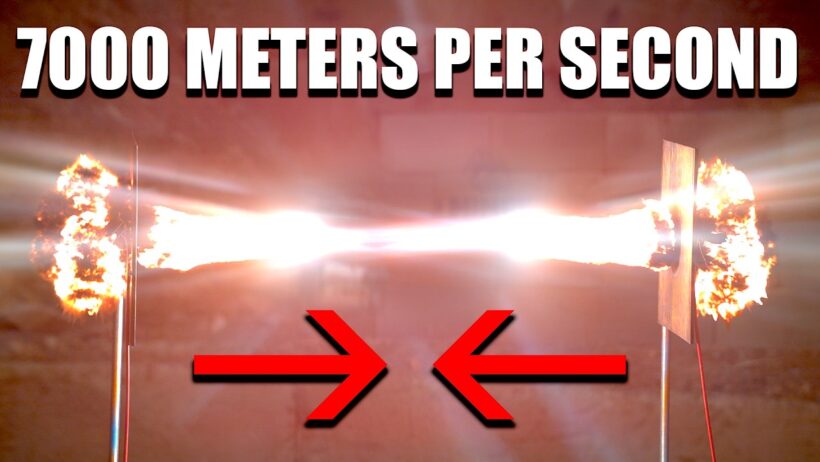

Explosive collisions are captivating phenomena, often used in cinema and science exhibitions alike to highlight the spectacular results of energy transformation. One might marvel at the rapid sequence of events that transpire during these collisions; however, a deeper inquiry into whether energy is conserved during such occurrences reveals a complex interplay of principles from physics, particularly the laws of thermodynamics and momentum conservation. Delving into the enigmatic world of explosion collisions invites us to ponder the foundational tenets of energy and its conservation, entwining it with the broader implications this has for our understanding of natural phenomena.
Before diving into the mechanics of energy conservation, it’s essential to establish what constitutes an explosion. At its core, an explosion is an energetic reaction that releases a significant amount of energy rapidly, often producing shock waves, heat, and a disruptive force. This energy originates from the chemical potential stored in the materials involved, whether they’re explosives or simply gases igniting. When the reaction occurs, the stored potential energy is transformed into kinetic energy, thermal energy, and sound energy, resulting in a visible and auditory spectacle.
According to the conservation of energy principle, energy in an isolated system cannot be created or destroyed. Instead, it merely changes forms. In the context of an explosion, one might intuitively presume that the vast energy released during the reaction signifies a loss of energy. However, when scrutinizing the entire system—including the heat dissipated into the environment, sound waves generated, and the kinetic energy imparted to debris—the conservation principle remains intact. The energy is redistributed rather than obliterated.
The principle of conservation extends beyond mere energy forms. The law of conservation of momentum plays a critical role in understanding explosive collisions. Momentum, defined as the product of an object’s mass and its velocity, must remain constant in the absence of external forces. During a collision where an explosion occurs, fragments are propelled away from the initial point of detonation. The momentum before the explosion (which can be considered zero if at rest) must equal the total momentum after the explosion as fragments scatter at high velocities. In this sense, both conservation of energy and momentum work in tandem, providing an overarching framework to analyze the physical phenomena.
In practical application, the observation of energy conservation in explosive events also translates into engineering and safety practices. For instance, engineers must account for energy dissipation in designing structures to withstand explosions, be it in military applications, mining, or demolition jobs. Understanding the energy transfer and momentum distribution informs the creation of protective barriers, shock absorbers, and safe distances from potentially hazardous activities. Thus, the fascination with explosion collisions not merely lies in their dramatic spectacle but also in their significant implications for safety and efficiency in technology.
Furthermore, one must consider the environmental ramifications of explosive collisions. With the rising concern over energy conservation and its implications for climate change, the impact of explosive reactions, especially in industrial settings, merits scrutiny. Harnessing energy that is released during such reactions can be applied to create more sustainable methods of extraction or demolition. The enthusiasm for converting waste energy into useful forms—such as harnessing kinetic energy from debris—opens avenues toward greener technologies, underscoring the need to integrate scientific findings with environmental stewardship.
Another compelling dimension lies in the psychological allure of explosions. Explosions often evoke visceral emotions, from awe to fear, compelling us to investigate the underlying physics at play. This fascination is not just limited to entertainment; it invokes a profound curiosity about the natural world and the laws governing it. The spectacle of synchronized explosions in fireworks, for example, serves as a reminder of how energy can be manipulated and safely harnessed for celebration and cultural practices across societies.
Importantly, understanding the mechanics of explosion collisions can enlighten discussions around renewable energy sources. As the world pivots toward sustainable practices, recognizing the parallels between explosive energy release and renewable energy generation—such as geothermal, solar, or wind energy—can provide critical insights. It involves not only the appreciation of the conversion of energy but also the realization that utilizing existing natural systems can inform better practices and technologies moving forward.
Explorations into the realm of explosions and their energy implications educate and inform decisions that affect environmental policy and industry standards. Emphasizing these principles through rigorous study can help pave the way for innovative technologies that harness energy while minimizing harmful side effects. In a broader context, it addresses our societal responsibility to prioritize energy conservation while seeking to understand the marvelous workings of physics that govern our universe.
In conclusion, the investigation into whether energy is conserved during explosion collisions transcends mere curiosity; it invites an exploration of fundamental physics, engineering principles, and environmental ethics. The dual application of energy and momentum conservation provides robust explanations for these captivating phenomena. Consequently, understanding the energy transformations in explosive scenarios becomes not only a matter of academic interest but also a critical consideration for future technologies that valorize sustainability while acknowledging the powerful forces at play in our physical world.