

As an illustrious ship sailing through a tempestuous sea, an object in freefall through a fluid presents a fascinating study in the realms of physics and energy. When considering whether energy is conserved in this scenario, we venture into the realms of dynamics that are almost poetically intricate. Understanding this phenomenon requires one to plunge into the depths of conservation laws and the mechanics of fluids, thereby revealing the synergies and interplay that define our physical universe.
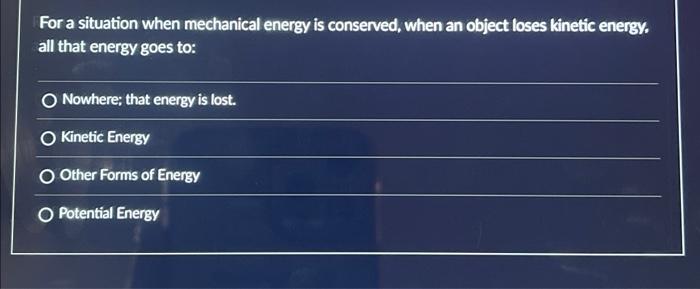
To embark on this exploration, one must first establish a foundational understanding of energy conservation. The law of conservation of energy dictates that within a closed system, the total energy remains constant. However, as an object descends into a fluid, the environment becomes pivotal. Forces, such as drag and buoyancy, emerge as consequential actors that complicate the otherwise straightforward equation of energy conservation.
In the absence of external forces, when an object falls freely under the influence of gravity, it converts potential energy into kinetic energy in a seemingly idyllic ballet of energy transformation. This process adheres strictly to conservation principles. Nevertheless, when an object traverses the viscous embrace of a fluid, the interplay shifts from a singular energy exchange to a dialogue filled with nuances. Here, the enigmatic forces of drag and buoyancy come into play – two formidable opponents that siphon and manipulate energy from the object itself.
The phenomenon of drag is analogous to a powerful tide that slows a vessel’s movement through water. As an object moves through a fluid, it encounters resistance that dissipates kinetic energy in the form of thermal energy; this is typically referred to as drag force. This resistive force is contingent upon several factors including the object’s velocity, shape, and the viscosity of the fluid. As a result, part of the kinetic energy is lost to the environment, presenting a complex scenario where not all the energy converts into useful work or motion.
Consider a smooth stone that drops into a still pond. Initially, it possesses gravitational potential energy, ready to be transformed into kinetic energy as it falls. Yet as it plunges beneath the surface, the drag from the water decelerates the stone, ensuring that not all potential energy transforms into kinetic energy. Instead, a portion is unceremoniously dispersed as heat, illustrating a captivating reality: energy is not merely transferred but also dissipated.
Furthermore, buoyancy serves as a counteracting force that influences the descent of the object. Archimedes’ principle tells us that any object immersed in a fluid experiences an upward force; this buoyant force can affect the net force acting on the object and, as such, alters its acceleration. As the object descends, it faces increased buoyancy which begins to compete with the downward gravitational pull. The interplay between these forces paints a comprehensive picture of energy distribution within the system.
This interaction hearkens back to the metaphor of the willful ship navigating turbulent waters where the winds and current can either override or augment its intended course. The ship’s energy is not exclusively its own; it transforms and transmutes in response to external forces. In this case, the object’s energy is similarly diminished as it interacts with subliminal forces in the fluid, showcasing that while energy is conserved, it is frequently in a non-useful form, obscured from our immediate perception.
It is also essential to acknowledge the distinct scenarios of terminal velocity wherein the forces of gravity, drag, and buoyancy reach equilibrium. In this state, the object no longer accelerates but rather adopts a constant velocity. The energy dynamics change; kinetic energy stabilizes, while potential energy diminishes. Nevertheless, the overall energy remains conserved even if its form seems to wane in the presence of counteracting forces.
Moreover, the intricacies of fluid dynamics can lead to scenarios where energy can appear to vanish from one perspective while concurrently being harnessed or transferred in another manner. Viscosity plays an essential role in dictating the behavior of fluids and their resistance to objects in motion. As the object pushes against the fluid, the energy transfer occurs within the fluid medium itself, distributing energy and generating currents that can be harnessed or felt elsewhere, perhaps far from the initial point of entry.
From an ecological perspective, understanding these principles is crucial. Conservation of energy must echo through our environmental practices. The interactions between objects and fluids in nature exemplify the delicate balance of ecosystems. Nature has mastered the art of energy transformation and conservation even amidst losses. These principles extend to a broader discourse on how societies can innovate toward sustainability.
In conclusion, the inquiry into whether energy is conserved when an object falls through a fluid reveals a tapestry richly woven with the threads of physics, nature, and metaphors of navigation. While energy is, indeed, conserved in totality, the form it takes and its accessibility is dictated by environmental forces. Hence, the answer pivots upon perspectives, yielding a greater appreciation for the complexities of energy dynamics within fluid systems. The falling object, much like a ship embarking across uncharted waters, encounters challenges that illustrate greater lessons in energy conservation, aiding us in our pursuit of harmony with the physical world.