


When contemplating the dynamics of collision, one might imagine two dancers on a stage, gracefully intertwining their movements. Yet, as they come together, one must ponder: is momentum conserved, or does it dissipate like a forgotten melody? The nuances of kinetic energy in collisions reveal a tapestry woven with intricacies that are both enlightening and enigmatic.
To comprehend whether kinetic energy is conserved in collisions, it is paramount to delineate the two principal types of collisions: elastic and inelastic. In an elastic collision, the dancers part ways, each retaining their vigor, with the total kinetic energy before the collision equaling the total kinetic energy after. Here, the energy of motion remains intact—a perfectly orchestrated display of conservation. Think of two perfectly round billiard balls striking one another: they bounce off, retaining their pre-collision exuberance and momentum. The laws of physics are adhered to, as energy is not lost, merely exchanged, reminiscent of the timeless dance of nature itself.
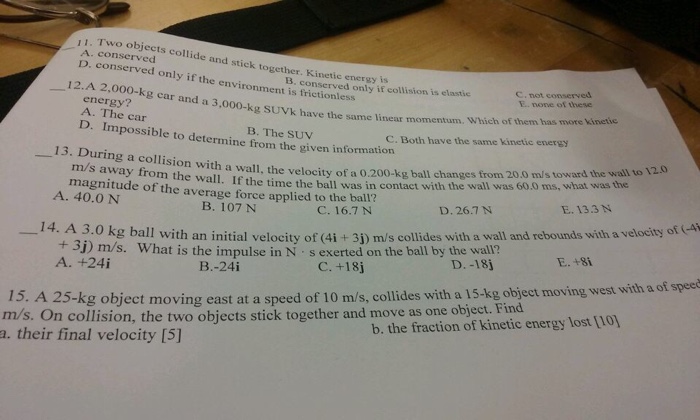
Conversely, in inelastic collisions, a transformation occurs upon contact. The dancers, rather than spinning away from each other, collapse into an embrace, their individual motions becoming one. This scenario is quite common in our empirical world, where some energy is invariably converted into other forms, such as thermal energy or sound, akin to the ‘thud’ of a silent stage rendered vibrant by the presence of human breath. In this case, the kinetic energy before the collision is greater than that post-collision. While momentum remains conserved due to Newton’s third law, kinetic energy does not share the same fate.
To elucidate this principle, consider a concrete example: two vehicles colliding at an intersection. When a fast-moving car strikes a stationary vehicle, the collision serves as a microcosm of energy exchange. The kinetic energy of the moving vehicle dissipates, partly in the form of sound, heat, and deformation of metal—the aftermath resembling a shattered mosaic of what once was. This transmutation of energy underscores the reality that while the total momentum of the system remains intact, the kinetic energy irrevocably alters, weaving into the frameworks of energy conservation and dissipation.
At the heart of these phenomena lies the conservation of momentum. This principle, akin to an omnipresent force, dictates that the total momentum of a closed system remains constant if no external forces intervene. Therefore, even amidst the tumultuous chaos of a collision, the focus on momentum allows for a clearer understanding of the energetic exchange. Following the interaction, while kinetic energy may experience a torrent of transformation, momentum can be likened to an ever-persistent tide, unyielding and reliable.
Figuratively, one might envision the dance as a series of waves, each cresting and crashing with fluidity. As energy transitions from kinetic to other forms, one can perceive the echoes of conservation principles resonating throughout. In nature, the universal laws govern not only physical interactions but extend their ethereal grasp to environmental considerations. The kinetic energy dissipated in inelastic collisions contributes to heating the environment, ultimately weaving a narrative in which energy transitions influence ecological balances.
Further, the world around us witnesses a cacophony of inelastic collisions: from a car crash on city streets to the softening of a clay sculpture through the artist’s hands. These demonstrations of energy conservation convey societal implications, as kinetic energy often spirals out into forms that can be harnessed or, regrettably, wasted. The environment, rife with energy transformations, invokes a pressing need for prudent conservation, whereby technologies are designed to minimize waste and maximize efficiency. In these contexts, the essence of kinetic energy plays a pivotal role, propelling forward the discussion of sustainability.
As we draw closer to understanding the intersections of kinetic energy and conservation principles, it becomes essential to acknowledge the role of technology in harnessing these energies. Innovations in industries, from automotive engineering to renewable energy, reflect an ongoing endeavor to catch the ebb and flow of kinetic energy in a manner that affirms sustainability. Advanced materials and designs aim to preserve momentum, reduce energy loss, and ultimately foster a symbiotic relationship with our planet’s resources.
In summation, the exploration of kinetic energy during collisions offers profound insights into the intricate dance of physics. While elastic collisions illuminate the beauty of energy conservation, inelastic collisions illustrate the complex reality of energy transformation. The laws governing momentum serve as steadfast guides through this labyrinth, maintaining equilibrium even as kinetic energy shifts and changes form. Each collision, whether in a laboratory or a bustling city street, serves as a reminder of the interconnectedness of physical principles and the broader environmental discourse. As we traverse this realm, we must continually seek harmonious practices that ensure kinetic energy and the environment harmonize, fostering a sustainable future that pays homage to the laws of nature.