


In the realm of classical mechanics, the interplay between kinetic energy and momentum often evokes lively discussion among scholars and enthusiasts alike. Both concepts serve as pivotal components in understanding the motion of objects, yet they exhibit distinct characteristics that can lead to surprising revelations. The inquiry into whether kinetic energy is conserved when momentum is conserved unveils a multifaceted tapestry of physics principles.
**Understanding Kinetic Energy and Momentum**
Kinetic energy, denoted by the symbol ( KE ), is a scalar quantity defined as the energy that an object possesses due to its motion. Mathematically, it is expressed as:
KE = (1/2) mv²
where ( m ) represents mass and ( v ) signifies velocity. This formulation indicates that kinetic energy increases with the square of the velocity, making it extremely sensitive to changes in speed.
On the other hand, momentum (( p )) is a vector quantity defined as the product of an object’s mass and velocity:
p = mv
Unlike kinetic energy, momentum possesses directionality, tying its analysis closely to the trajectories of moving bodies. A fascinating aspect of momentum is its conservation principle: in an isolated system, the total momentum before an event, such as a collision, equals the total momentum after the event. This principle holds true irrespective of the nature of the collision, whether elastic or inelastic.
**Divergence of Conservation Laws**
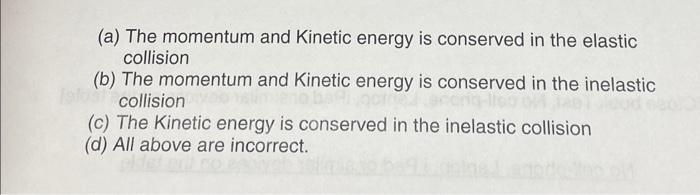
While both kinetic energy and momentum are conserved in certain contexts, a crucial divergence occurs during collisions. In elastic collisions, both momentum and kinetic energy are conserved. This is often exemplified by two perfectly rigid bodies colliding, where they bounce off each other without any loss of energy.
Conversely, in inelastic collisions, momentum remains conserved but kinetic energy is not. When two objects collide and stick together, their combined mass moves with a common velocity post-collision. Although the total momentum pre- and post-collision remains unchanged, some kinetic energy is converted into other forms of energy, such as thermal energy or deformation energy, thus leading to a decrease in the total kinetic energy of the system.
The contrast invites further inquiry. Why do we observe this behavior? The resolution lies in the nature of energy conversion and the specific conditions of each collision type.
**Analyses of Collisions**
Consider a head-on elastic collision between two identical masses. If they collide with equal but opposite velocities, they will exchange momentum and kinetic energy symmetrically. Post-collision, the two bodies will reverse their velocities. Here, both conservation laws hold, exemplifying a neat illustration of the synergy between momentum and kinetic energy.
In stark contrast, during an inelastic collision, such as a vehicle crash, the participating objects crumple and deform. The kinetic energy that once propelled the vehicles is dissipated, transformed into sound, heat, and permanent deformation—the very essence of energy transformation in action. The seemingly simple collision reveals the profound complexities underlying these concepts.
**Implications and Applications**
The ramifications of understanding these conservation principles extend far beyond academic circles. Engineers, for instance, exploit these principles when designing safer vehicles. By analyzing collision scenarios, they can design crumple zones that absorb energy and reduce the impact transferred to passengers, demonstrating a tangible application of the conservation of momentum principle despite the loss of kinetic energy.
Beyond engineering, the conservation of momentum and the transition of energy forms surface in various physical systems, from billiard balls to celestial bodies. In astrophysical contexts, binary stars orbiting each other display momentum conservation perfectly. As they spiral slowly toward each other due to gravitational attraction, their kinetic energy evolves correspondingly, providing fertile ground for further explorations of motion on an astronomical scale.
**The Mysterious Realm of Quantum Mechanics**
The exploration of energy and momentum conservation reaches an intriguing dimension within the domain of quantum mechanics. Here, phenomena such as particle collisions and wave-particle interactions defy classical intuitions. Quantum theory introduces interpretations of energy and momentum that challenge orthodox perceptions, suggesting that the conservation laws may be more nuanced than previously imagined.
Indeed, the dual conservation laws converge intriguingly in the realm of quantum entanglement and superposition, where the behaviors of particles extend far beyond classical boundaries. This exploration beckons the curious mind to delve deeper into the mysteries of the universe, where conservation rules may not always align with classical expectations.
**Conclusion**
Engaging with the question of whether kinetic energy is conserved when momentum is conserved unravels a landscape rich in complexity and wonder. While momentum inherently withstands the tests of various collision types, kinetic energy’s fate is contingent upon the nature of the interaction. Understanding these distinctions not only fosters a deeper comprehension of physical interactions but also encourages innovative thinking in applied sciences. Through an appreciation of these conservation laws, one begins to realize the profound interconnectedness of motion, energy, and the very fabric of our universe—a reminder of the beautiful intricacies awaiting exploration within the principles of physics.