
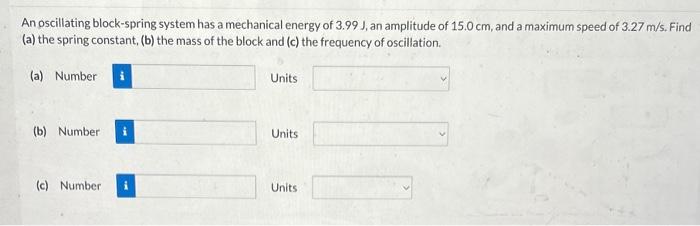

Mechanical energy is a pivotal concept in the study of physics, particularly within the realm of oscillatory systems. When we examine a block-spring system subjected to oscillation, we must ask: Is mechanical energy conserved throughout this dynamic process? The answer lies in understanding the principles of energy conservation and the factors that influence oscillation in such systems.
First, let us delve into the fundamental definitions of mechanical energy. Mechanical energy comprises two primary components: kinetic energy and potential energy. Kinetic energy is the energy of motion, calculated by the formula ( KE = frac{1}{2} mv^2 ), where ( m ) is the mass and ( v ) is the velocity of the object in motion. In contrast, potential energy, specifically elastic potential energy in the case of a spring, is defined by the equation ( PE = frac{1}{2} kx^2 ), where ( k ) represents the spring constant and ( x ) denotes the displacement from the equilibrium position.
In an ideal scenario, where no external forces act on the system and no dissipative forces like friction or air resistance are present, mechanical energy remains conserved. Conservation of mechanical energy implies that the total mechanical energy of the system remains constant over time, oscillating between kinetic and potential forms. As the spring oscillates, the energy transitions back and forth, indicating mechanical energy conservation. For example, when the spring is at its maximum displacement, potential energy reaches its peak while kinetic energy is momentarily zero. Conversely, as the spring passes through the equilibrium position, kinetic energy maximizes and potential energy drops to zero.
To punctuate this point, consider the oscillation of a mass attached to a spring located in a frictionless environment. The block-spring system’s graceful rhythm epitomizes energy transformation. Every oscillation represents a cycle of energy conversion: potential energy is at its zenith at the extremes of motion, and kinetic energy reigns supreme as the mass surges through equilibrium. In this idealized system, despite the periodic changes in energy forms, the total mechanical energy remains invariant, demonstrating the conservation principle vividly.
However, real-world applications present a more nuanced scenario. In practical situations, factors such as friction, air resistance, and other forms of energy dissipation invariably interfere with mechanical energy conservation. When a spring oscillates in a medium like air, the moving block encounters atmospheric drag, converting some mechanical energy into thermal energy. This dissipation results in a gradual decrement of the system’s total mechanical energy, evidenced by a decrease in amplitude over successive oscillations. In such instances, the mechanical energy is not conserved, and one observes a transition towards thermal equilibrium, where the oscillating system eventually comes to rest.
Exploring further, one recognizes that the nature and characteristics of oscillation can also lead to intriguing effects related to energy conservation. For instance, in a damped oscillatory system, one can identify two principal categories: underdamped and overdamped oscillations. In underdamped systems, energy loss is minimal, allowing for several oscillations before ceasing, whereas, in overdamped systems, the block returns to equilibrium without oscillating due to excessive damping force. While both systems experience energy dissipation, the rate and manner of energy transformation differ. This reality invites consideration of whether one can recover that lost energy through alternative means, thereby prompting inquiries into innovative energy recapture technologies.
The interplay between energy loss and recovery beckons a reevaluation of how we approach energy management in oscillatory systems. Pioneering concepts such as regenerative braking in cars exemplify how understanding energy conservation guides the development of technologies that reclaim mechanical energy. By capturing energy typically wasted during deceleration and redirecting it to recharge batteries, engineers create systems that optimize efficiency and are profoundly compatible with sustainability ideals.
One can also theorize about the potential of oscillating spring systems in energy storage applications. By harnessing the oscillatory motion of springs in innovative ways, engineers can devise mechanisms that store energy for future use. This could have transformative implications for renewable energy systems, where harvesting energy generated under variable conditions is crucial. A spring-based energy storage system could complement solar or wind energy by absorbing excess energy during peak production periods, ultimately reallocating that energy during high-demand scenarios.
In summation, the question of mechanical energy conservation in oscillating spring systems intricately intertwines theoretical physics with practical implications. While ideal conditions showcase the elegant conservation of energy within these systems, real-world interference elucidates the complex layers of energy dynamics. As the quest for sustainability expands, reimagining mechanical energy conservation through innovative engineering and energy recovery techniques could yield revolutionary advancements in energy efficiency.
Encapsulating these concepts invites curiosity and fosters a deeper engagement with the science of energy. Energetic phenomena are not merely academic pursuits; rather, they present challenges and opportunities that can influence ecological practices for a sustainable future.