


As we delve into the intricacies of climate change, the dialogue frequently oscillates between two primary perspectives: the attribution of climate change to human activity versus viewing it as a natural cycle rooted in the Earth’s historical climatological patterns. Understanding these viewpoints is not merely an academic exercise; it has profound implications for policies, global cooperation, and our individual lives.
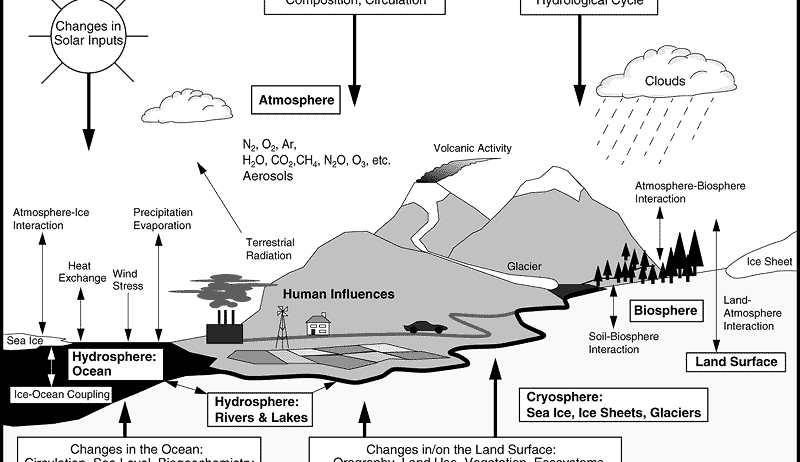
At the core of this discourse lies the question of causation. Consider, for a moment, the vast chronicle of Earth’s climatic history. For eons, our planet has experienced fluctuations in temperature due to natural forces. These include solar radiation variations, volcanic activity, and oceanic currents. Historical data, gathered through ice cores and sediment samples, reveals epochs of warming and cooling, confirming that climate does indeed undergo cyclical transformations independent of human influence. This cyclical perspective prompts inquiries into how the Earth can sustain these variations without abrupt or catastrophic shifts.
Nevertheless, recent scientific studies have illuminated an alarming truth: the current pace of climate change is unprecedented, and its primary driver is human activity. The Industrial Revolution heralded a seismic shift in how humanity interacts with the environment. The combustion of fossil fuels, deforestation, and industrial practices have unleashed an unprecedented influx of greenhouse gases (GHGs) into the atmosphere. This modern era is characterized by exponentially rising carbon dioxide levels, a phenomenon starkly distinct from the gradual fluctuations of natural cycles.
One might evoke the concept of the greenhouse effect to comprehend the mechanics of climate change. GHGs, including carbon dioxide (CO₂) and methane (CH₄), create a layer in the atmosphere that traps heat, thereby preventing it from escaping into space. This effect has naturally existed for eons, enabling life as we know it; however, anthropogenic emissions have intensified this phenomenon to alarming levels. As we examine temporal scales, it becomes evident that the shift from a stable climate to one experiencing rapid warming can be traced back to the post-industrial age.
The stark contrast between natural cycles and human-induced changes serves as a referendum on our priorities. Natural variations, such as the Milankovitch cycles, which describe variations in Earth’s orbit and axial tilt, operate over tens of thousands of years. In contrast, the current trajectory of climate change has crystallized in just a few centuries. The acceleration of temperature rises and the corresponding climate disasters present a direct challenge to humanity’s resilience. This dichotomy beckons a deeper understanding of the implications of our actions.
One cannot overlook the ramifications of methane emissions, which are significantly more potent than carbon dioxide in the short term, trapping heat effectively in the atmosphere. Agriculture, especially livestock production, contributes substantially to this challenge. As meat consumption rises globally, so too does the methane released into the atmosphere. This compels us to consider not just the greenhouse gas emissions from energy production but also the broader economic and dietary implications of our consumptive habits.
The debate also extends to uncovering the interplay of climate justice and equity. Historically marginalized communities are disproportionately affected by climate change, despite being the least responsible for GHG emissions. These communities possess valuable knowledge and resilience strategies shaped by their deep connection to the land. Recognizing their contributions to climate adaptation and mitigation is integral to fostering inclusive policies that address climate change comprehensively.
Understanding the mechanisms of climate change leads us to the urgent question: What can be done? The need for impactful action is paramount. Transitioning to renewable energy sources, enhancing energy efficiency, and adopting sustainable farming practices can significantly reduce our carbon footprint. Each individual possesses the capacity to influence change—whether by reducing energy consumption, advocating for legislative reforms, or investing in green technologies.
Explore the notion of carbon neutrality, which aims to balance carbon emissions by reducing, offsetting, or sequestering them. Governments worldwide are beginning to adopt ambitious targets for carbon neutrality, aiming for significant milestones such as net-zero emissions by 2050 or sooner. However, these targets will only be achieved through a confluence of policy changes, corporate responsibility, and individual action. The alignment of these forces is not just a utopian vision but a surging imperative.
In conclusion, the crux of climate change is multifaceted. While natural cycles undoubtedly contribute to the planet’s climate dynamics, overwhelming evidence underscores that human activity has become the dominant factor in the current trajectory of climate change. This moment requires heightened awareness, urgency, and action. By broadening our perspective and acknowledging our roles within this multifarious issue, we can collectively influence the narrative surrounding climate change. The dialogue must transition from division to cooperation, fostering a shared commitment to safeguarding our future. The time to act is now. Each small step, when multiplied by millions, can create a paradigm shift that transcends generations.